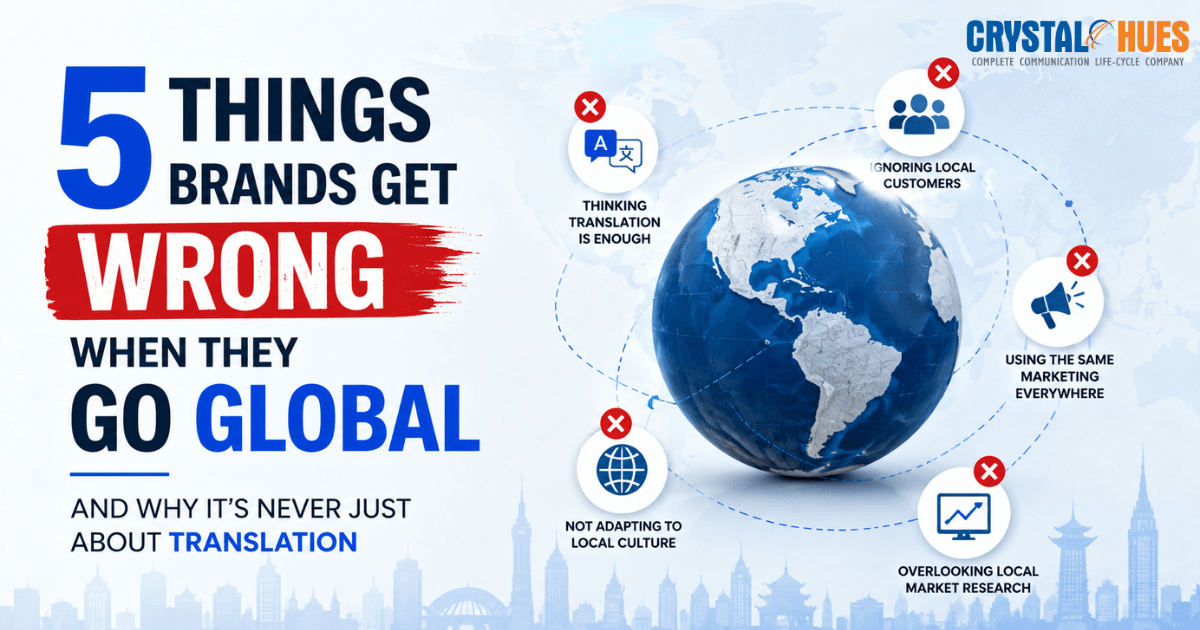
5 Things Brands Get Wrong When They Go Global — And Why It's Never Just About Translation
Most brands preparing for international
expansion spend months on pricing models, shipping partners, and demand
forecasts. That's the visible work, the part that shows up in board decks. What
rarely gets the same attention is the operational layer underneath it — the one
that decides whether a customer in Jakarta or Johannesburg actually trusts your
site enough to click "buy."
We've seen this pattern repeat across
industries: the launch goes fine on paper, then conversion rates in the new
market quietly underperform for months, and nobody can point to a single reason
why. Usually, it's not one big mistake. It's five smaller ones that compound.
Is Translation the Same as Localization?
Short answer: no, not even close.
Translation gets your words into another
language. Localization gets your meaning into another market. A product
description can be grammatically flawless and still fail to convince anyone,
because the phrasing doesn't match how people in that region actually talk
about the product, search for it, or decide to trust it.
This shows up in small places that add up
fast — a size chart that assumes US measurements, a headline built around an
idiom that doesn't survive translation, category names that don't match local
search behavior. None of these are dramatic errors. But each one adds a bit of
friction, and friction is what kills conversion in a market where a shopper has
zero brand loyalty to fall back on.
Real localization touches navigation,
search filters, checkout copy, and post-purchase emails — not just the product
page. If your team is only briefing translators on marketing copy, you're
localizing maybe 30% of what the customer actually sees.
Why Do Compliance Requirements Trip Up Even Experienced
Brands?
Because they change by country, sometimes
by state, and almost nobody keeps a live inventory of them.
Return policies, product disclosures,
data collection consent, packaging and labeling rules — every market has its
own version, and they rarely match. A brand that's been selling in the US for a
decade can still get blindsided by a labeling requirement in the EU or a
data-localization clause in a market it entered last quarter. It's not that the
rules are hidden. It's that keeping every piece of customer-facing content
aligned with every applicable regulation, across every market, isn't something
you set up once and forget.
The brands that manage this well treat
compliance as a content workflow problem, not a legal afterthought. Legal
defines the requirement; content operations makes sure it actually reaches
every page, every language version, every time something changes.
Does Your Checkout Actually Feel Local?
This is the point where a lot of
otherwise well-planned launches lose money quietly.
A shopper in Germany doesn't necessarily
want to pay by card. A shopper in parts of Southeast Asia may expect a wallet
option your payment gateway doesn't even support yet. If the checkout looks
unfamiliar — wrong currency display, an unrecognized payment logo, a form
asking for information that feels intrusive by local norms — people abandon the
cart. Not because the product was wrong. Because the last thirty seconds of the
journey felt foreign.
Brands that get this right stop treating
checkout as a technical configuration and start treating it as the final, most
sensitive piece of the localization puzzle. It deserves the same scrutiny as
the homepage.
Is Logistics Just an Operations Problem — Or Is It Part of
Your Brand?
By the time most customers think about
logistics, something has already gone wrong — a late parcel, a confusing return
process, a customs charge nobody warned them about.
Cross-border fulfilment adds real
complexity: customs documentation, region-specific delivery expectations,
return windows that vary by consumer protection law. Brands that treat this
purely as a backend function tend to discover the gaps only after customers
complain. Brands that treat it as part of the customer experience — building
delivery-time and return-policy messaging directly into the product page, for
instance — tend to earn more trust before the parcel even ships.
What Happens After Launch? (This Is the Part Most Teams
Underplan)
Going live in a new market isn't the
finish line. It's closer to the starting gun.
Once a market is active, content doesn't
stay static. Prices shift, campaigns rotate, regulations get updated, and
customer expectations keep climbing. A one-time localization push covers day
one; it doesn't cover month six. Without a system for ongoing content updates
across every live market, teams end up firefighting — patching outdated pricing
pages, catching up on regulatory changes after the fact, translating campaign
assets under deadline pressure instead of on a planned cycle.
The brands that scale internationally
without losing quality are the ones that built a repeatable operating rhythm
from day one: a clear workflow for who updates what, in which language, by
when, and how it gets reviewed before it goes live.
The Common Thread
None of these five gaps are about
ambition or product-market fit. They're about infrastructure — the unglamorous
systems that sit behind every market a brand enters. Get them right early, and
expansion into the next market gets faster, not slower. Ignore them, and every
new market starts to feel like starting over from scratch.
At Crystal Hues, this is the layer we work in every day — building the localization, content, and compliance workflows that let brands enter new markets without losing the operational thread that holds the whole experience together. If your team is mapping out its next market and wants a second set of eyes on where the gaps might be, reach out to our experts.