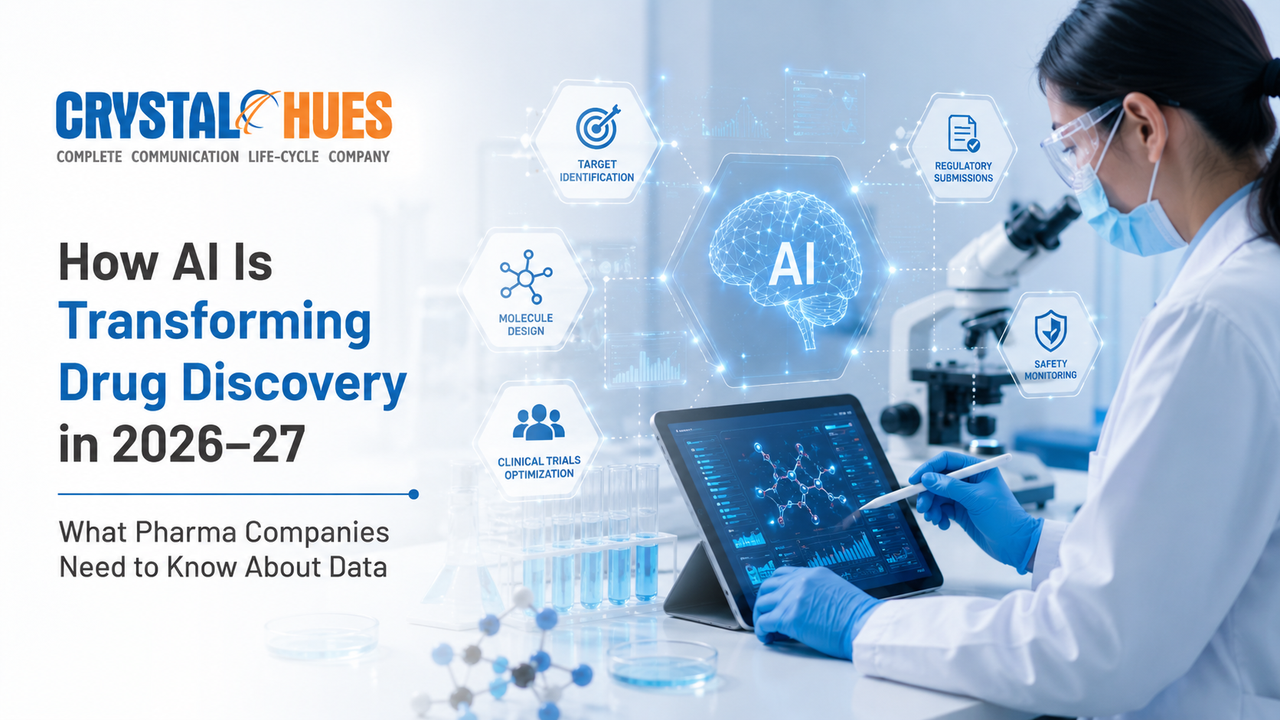
How AI Is Transforming Drug Discovery in 2026–27: What Pharma Companies Need to Know About Data
Post Covid, the monetary and social impact of global drug discovery has found its relevance across the world and AI is at the forefront expediting the process for researchers and pharma companies. The race to discover the next breakthrough drug has always been defined by time, cost, and complexity. A single molecule moving from lab to market can take over a decade and cost billions. In 2026 and 2027, artificial intelligence is fundamentally rewriting those numbers, and the pharma industry is paying attention. But behind every AI-powered discovery sits an infrastructure most organisations are only beginning to build. Clean data. Structured data. Labelled, validated, and domain-specific data. That gap between AI ambition and AI readiness is where the real transformation is happening and where the right data services partner becomes critical. The first stage of drug discovery to identify which biological target to pursue has traditionally relied on years of manual research. AI models trained on genomic, proteomic, and clinical datasets can now surface high-probability targets in a fraction of the time. For these models to perform accurately in a pharma context, they require domain-specific training data that reflects the language, structure, and logic of life sciences. Crystal Hues's domain-specific expertise service ensures that AI systems used in pharma research are trained on data that speaks the language of the field and not generic datasets that introduce noise rather than signal. Generative AI tools are now capable of proposing novel molecular structures with predicted efficacy and safety profiles. The challenge is that these tools are only as good as the datasets they learn from. Poorly labelled or inconsistently structured chemical and biological data produces unreliable outputs. Crystal Hues's AI data annotation and labelling service addresses this directly, applying structured, accurate labelling to complex scientific datasets so that machine learning models can train with the precision pharma demands. Clinical trial design is one of the most data-intensive stages in the drug development process. AI is now being applied to patient stratification, protocol optimisation, and adverse event prediction. Decentralised trials, which became mainstream post-2020, are generating multilingual data across dozens of geographies simultaneously. This creates a significant data management challenge. Trial data arriving in multiple languages, formats, and structures needs to be cleaned, standardised, and made AI-ready before it can be used. Crystal Hues's AI data cleaning and pre-processing service is built precisely for this by transforming raw, fragmented datasets into structured inputs that analytics and AI systems can reliably use. For global trials specifically, Crystal Hues's data text translation and localisation service ensures that patient records, informed consent documents, and protocol materials retain full scientific accuracy across languages — a regulatory requirement that cannot be left to general-purpose translation tools. Regulatory bodies including the FDA and EMA are actively developing frameworks for AI-generated submissions and AI-assisted review processes. In 2026, the expectation from regulators is not just that AI tools are used — it is that the data underpinning those tools is traceable, validated, and of verifiable quality. Crystal Hues's data quality assurance and evaluation service provides pharma organisations with an independently verified layer of data integrity. Combined with Crystal Hues's data security and privacy support, organisations can build AI pipelines that are compliant by design. Drug safety monitoring after approval is an area where AI is generating significant new capability. Natural language processing tools are scanning adverse event reports, social media signals, and clinical notes to surface safety concerns faster than traditional pharmacovigilance methods allow. Building these tools requires training data that captures the full range of how patients and clinicians describe drug effects across demographics, languages, and healthcare contexts. Crystal Hues's sentiment and emotion analysis service and semantic annotation service provide the structured, nuanced training data these surveillance models depend on. Where multilingual coverage is needed, Crystal Hues's AI data collection and sourcing capabilities span global linguistic datasets with native-level quality control. Here is what the headlines about AI in pharma often miss. The algorithms are largely ready. The gap is in the data that feeds them. Most pharma organisations working with AI in 2026 are discovering that their internal data, be it clinical records, research outputs, trial documentation, or regulatory filings, exist in forms that AI cannot yet use effectively. It is unstructured, inconsistently labelled, multilingual, or locked in legacy formats. Closing that gap requires a partner with both deep linguistic capability and rigorous data process expertise. Crystal Hues's full suite of AI data services, from collection and annotation through to quality assurance, semantic enrichment, and model testing and feedback, is designed to make pharma data AI-ready at scale. With 36 years of linguistic expertise, ISO certifications across quality, security, and translation standards, and a global network of domain-specific annotators and linguists, Crystal Hues brings the infrastructure that pharma AI initiatives need to move from pilot to production. Today, AI-driven drug discovery is the baseline expectation. However, the organizations that succeed fastest are not necessarily those with the most advanced algorithms. They are the ones who invested early in building trustworthy, structured, high-quality, and multilingual data pipelines. At Crystal Hues, our pharma AI data services are designed to support every stage of the AI journey, enabling pharmaceutical companies to build, train, and scale AI models with confidence. As the race for the next breakthrough drug accelerates, organizations need dependable data partners and that's where Crystal Hues delivers value through quality, accuracy, scalability, and domain expertise. Target Identification Is Getting Smarter
Molecule Design and Lead Optimisation
Clinical Trials Are Being Redesigned Around Data
Regulatory Submissions Are Becoming AI-Assisted
Post-Market Surveillance Is Expanding in Real Time
The Infrastructure Gap No One Talks About
What Comes Next