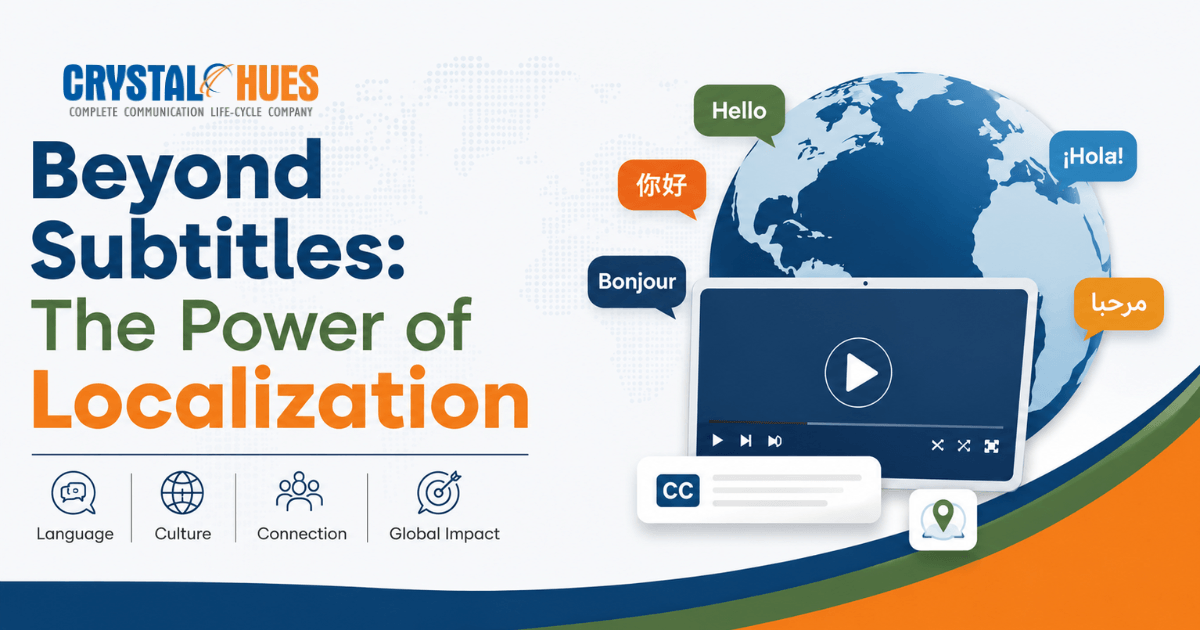
Beyond Subtitles: The Power of Localization
Connecting Global Audiences
The rise of digital commerce has
democratised the access of service and products to users. They have matured and
they reward genuine connection over the commercial value a service or product offers.
Streaming platforms have spent the last
decade turning subtitle quality into a science. Netflix's own timed text style guide caps adult content at roughly 20 characters per second, limits each
line to 42 characters, and allows a maximum of two lines per cue, since the
character limit exists so subtitles remain readable within the time available on screen.
That level of precision exists for a
reason. Viewers today are digitally fluent. They notice when a subtitle lags
the dialogue, when a line breaks mid-sentence, or when a joke reads flat in translation.
A single misstep in reading speed or phrasing can quietly undo weeks of production and localization effort. This is where localization earns its place, not as a translation add-on, but as the layer that decides whether a global audience connects with the content in front of them.
Accuracy Was Never the Problem
This is a pattern that catches many global
brands off guard. The subtitles were not wrong. Every word matched the source
script. Yet the message still fell flat.
Understanding language and connecting with an audience are two very different achievements. A viewer can read a perfectly translated line and still feel nothing, because humour, tone, and emotional rhythm rarely survive word for word translation.
This is the exact gap between translation
and true localization.
Why Subtitle Timing Affects More Than
Readability
Poor subtitle timing does not just make
text harder to read. It increases cognitive load; the mental effort a viewer spends decoding text instead of absorbing the story.
Netflix's own guidance recommends keeping subtitles on screen slightly longer than the dialogue itself, since extra time gives viewers room to read comfortably rather than racing to finish before the
cue disappears.
When that buffer is missing, viewers split
their attention between reading and watching. Over an entire episode or
campaign video, this steady low-grade strain adds up, and engagement quietly
drops even though comprehension technically holds.
This is a formatting problem with an
emotional consequence. Fixing it protects far more than legibility.
Where Real Localization Gaps Show Up
A closer review of underperforming subtitles usually reveals a familiar pattern. Cultural references built around
local humour, idioms, or sports metaphors do not translate cleanly into another
market.
A phrase like "hit it out of the
park" carries no meaning for an audience unfamiliar with baseball. A pun
built on English wordplay simply disappears once translated literally.
Line breaks that split a sentence at the
wrong point can also disrupt reading rhythm and slow comprehension down at
exactly the moment a message needs to land.
None of these are translation errors in the
traditional sense. They are localization gaps, the kind that only surface when content is tested the way a real audience watches it.
Minimal Changes, Maximum Impact
Small, deliberate adjustments tend to solve
most of these issues. Idioms and sports metaphors get rebuilt using culturally equivalent expressions rather than literal translations, so the emotional beat
lands the way it was intended.
Word order is adjusted to match the natural sentence flow of the target language, since sentence structure that works in English often reads awkwardly translated word for word.
Line breaks are placed at natural grammatical points, following the same logic behind industry conventions like
Netflix's line-splitting rules, so viewers are not left parsing a sentence that
has been cut in an unnatural place.
Voice-over synchronization gets equal
attention in dubbed content, matching not just word timing but mouth movement
and pacing, so the delivery feels native rather than dubbed on top of the
original.
Why This Matters Beyond Video
This principle extends well beyond subtitles. Any content built for a global audience, from marketing videos to
product explainers to training material, carries the same risk.
Literal accuracy protects the words on
screen. It does not automatically protect the feeling behind them. The W3C's
accessibility guidelines for captions make a similar point, emphasizing that captions should preserve meaning and tone, not just transcribe dialogue.
Video and multimedia content built for
global markets deserves the same rigour. Timing, cultural nuance, and audience response need to be evaluated together, because a script that reads correctly can still fail to resonate if these elements are left unchecked.
Where Crystal Hues Fits In
The best practice here is straightforward.
Subtitling and voice-over work should be treated as a creative and technical
discipline, not a mechanical translation pass, with reading speed, line breaks,
cultural references, and audio sync all reviewed as one connected system.
Crystal Hues applies this approach across
its video localization and subtitling services, evaluating timing, cultural
nuance, and on-screen delivery together rather than checking translation accuracy in isolation.
Conclusion
Subtitle accuracy proves that words have been translated correctly. It does not prove that a story has been told well.
Reading speed, line length, cultural reference, and voice sync all shape how an audience experiences content, often
more than the literal translation it self. Getting the words right earns
comprehension. Getting the delivery right earns connection.
For any brand building content across
borders, that difference decides whether a global campaign truly lands or
simply gets understood. Explore how Crystal Hues'
localization services bring that level of precision to global video content.