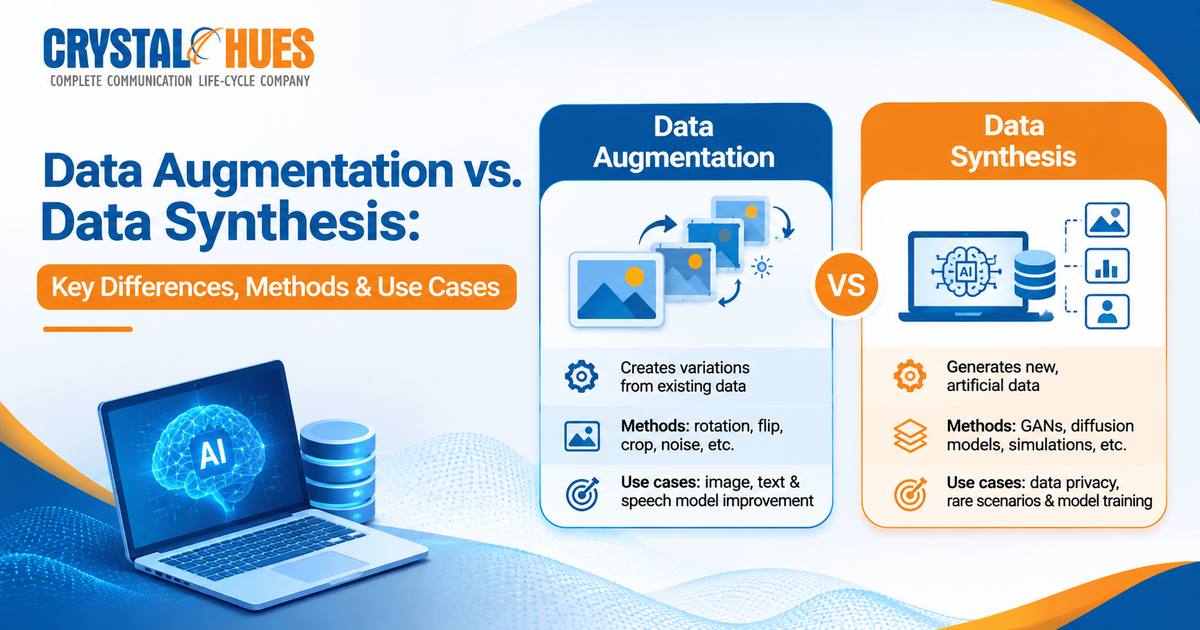
Data Augmentation vs. Data Synthesis: Key Differences, Methods & Use Cases
Introduction
Data Augmentation and Data Synthesis are
similar words with nuanced meanings. As the word suggests, augment means to
increase while synthesis creates something new.
Every AI model learns from the examples it is given, so the quality of its training data matters a great deal. Datasets need to be large enough, varied enough and close enough to real-world conditions. When real data falls short, teams often turn to two ideas that get mixed up: data augmentation and data synthesis. To put in context, augment when you have existing data and do synthesis if you need new data for models.
What Is Data Augmentation?
Data Augmentation can be defined as augmenting or adding new data to existing data to
improve model’s performance. You start with real examples and create modified
versions of them. The goal is to improve robustness and generalization without
collecting everything from scratch.
Common examples include flipping or cropping an image, paraphrasing a sentence, changing the speed of an audio clip or adding light background noise. In multilingual work, it can also include language or dialect variants, where they suit the task.
What Is Data Synthesis?
Data Synthesis, often called synthetic data generation, means creating new data
that represents useful patterns or scenarios. Instead of modifying a real
example, the system produces a fresh one. This is usually done with generative
models, simulations or rules.
Examples exist for every data type. In text, a language model can write sample customer queries. In images, a simulator can render road scenes with rare weather conditions. In audio, speech can be generated for specific accents or environments. In tabular data, a statistical model can produce records that follow the patterns of a real table.
Data Augmentation vs. Data Synthesis: Key Differences
The simplest way to separate them is by
starting point. Augmentation usually begins with existing real examples and
changes them, while synthesis generates new examples from generative models,
simulations, rules or statistical patterns, often informed by real data.
The methods also differ. Augmentation
typically uses flips, crops, paraphrasing, noise and back-translation to vary
what already exists. Synthesis relies on generative models, simulators,
templates and probabilistic models to produce samples from scratch. Because of
this, augmentation is limited by the source data, so its controllability is
moderate. Synthesis is often easier to control, since teams can design specific
scenarios on purpose.
Augmentation is mainly used to improve
robustness and add variety to data that is already good but narrow. Synthesis
is more useful for covering rare, costly or unsafe scenarios that are hard to
capture in real life.
Augmentation can cause label drift, unrealistic changes and limited new information, so the main check is that labels and meaning are preserved. Synthesis can produce unrealistic samples, amplify bias or leak private details, so it must be checked for realism, usefulness, privacy and bias.
Common Data Augmentation Methods
We
have methods in place where the right technique depends on the type of data.
For images, teams use cropping, flipping,
rotation, brightness and colour changes, and carefully applied noise. The key
is to keep the object recognizable.
For text, common methods include
paraphrasing, controlled word substitutions, back-translation and templates,
provided the meaning stays the same. Changing “not satisfied” to “satisfied”
would flip the sentiment and damage the label.
For audio, speed and pitch changes, added
background noise and channel variation all work within realistic limits. A
model for call-centre speech should hear phone-line quality, not studio effects
it will never meet.
For tabular data, options include justified
transformations, resampling and small feature-level changes. The relationships
between columns must still make sense, or the data stops reflecting reality.
Teams that need this at scale often rely on specialist data augmentation services to keep quality consistent.
Common Data Synthesis Methods
There are four main approaches.
Generative AI uses trained models to
produce text, images, audio or records that resemble the patterns they learnt.
Simulation and synthetic environments
create data from virtual worlds, such as driving scenes or factory floors. They
are useful where real capture is dangerous or expensive.
Rule-based and template-based generation
builds samples from defined patterns, such as filling slots in sentence
structures. It is predictable and easy to audit, though less varied.
Statistical or probabilistic generation
suits structured data, where a model learns distributions from a real table and
samples new rows from them.
No method wins everywhere. Suitability depends on the data type and the task the model must perform.
Benefits, Limitations & Risks
Both approaches can broaden coverage,
represent rare scenarios better and support testing when real data is limited.
They can also reduce the effort of collecting everything manually.
The risks deserve equal attention. Samples
can be unrealistic or contain artifacts that a model learns by mistake. Labels
can drift away from their original meaning. Bias in the source data can be
amplified rather than reduced. Synthetic data can leak private details from the
data it learned from. The resulting dataset can also differ from real-world
conditions, and models can come to over-rely on generated examples.
The safeguard is the same in every case: review by people who understand the domain, and evaluation on representative held out or real-world data. Strong AI data preprocessing and clear AI data annotation and labelling also keep these risks in check.
When Should You Use Data Augmentation or Data Synthesis?
Since the nuances of these two are too varied,
choosing one over the other depends on the purpose. If we have already useful
source examples and adding variations could improve the model, then
augmentation will be preferred. On the other hand, if the scenarios you need
are scarce, expensive, difficult or unsafe to collect, such as rare failures or
sensitive situations, then it calls for rigorous validation through data
synthesis.
Choosing both by augmenting real data and adding targeted synthetic samples for gaps can also give the desired outputs. If your real data is thin to begin with, it also helps to review your AI data collection and sourcing before adding more variation on top.
How Crystal Hues Supports Data Augmentation
Crystal Hues
offers data augmentation as part of its wider AI data services, which
also cover collection, annotation, cleaning and quality checks. Its
augmentation work includes textual variations, cross-lingual enrichment, entity
and identifier variations, domain-specific adaptation and AI-generated training
datasets.
Planning to strengthen your training data? Explore our data augmentation services or talk to the Crystal Hues team about what your dataset needs.
Frequently Asked Questions
Is data augmentation the same as data
synthesis?
No, they differ as augmentation increase
the already existing data, but synthesis generates new data.
Can data augmentation create synthetic
data?
Some augmentation methods, such as
model-generated paraphrases, can create synthetic examples from real ones.
What is an example of synthetic data?
Example of synthetic data include a
simulated driving scene.
Which is better for machine learning:
augmentation or synthesis?
It depends
on the data type, the task and how well the result performs on real data.
How do you validate augmented or
synthetic datasets?
We validate by checking the labels and
meaning, bias check and test for privacy leakage.