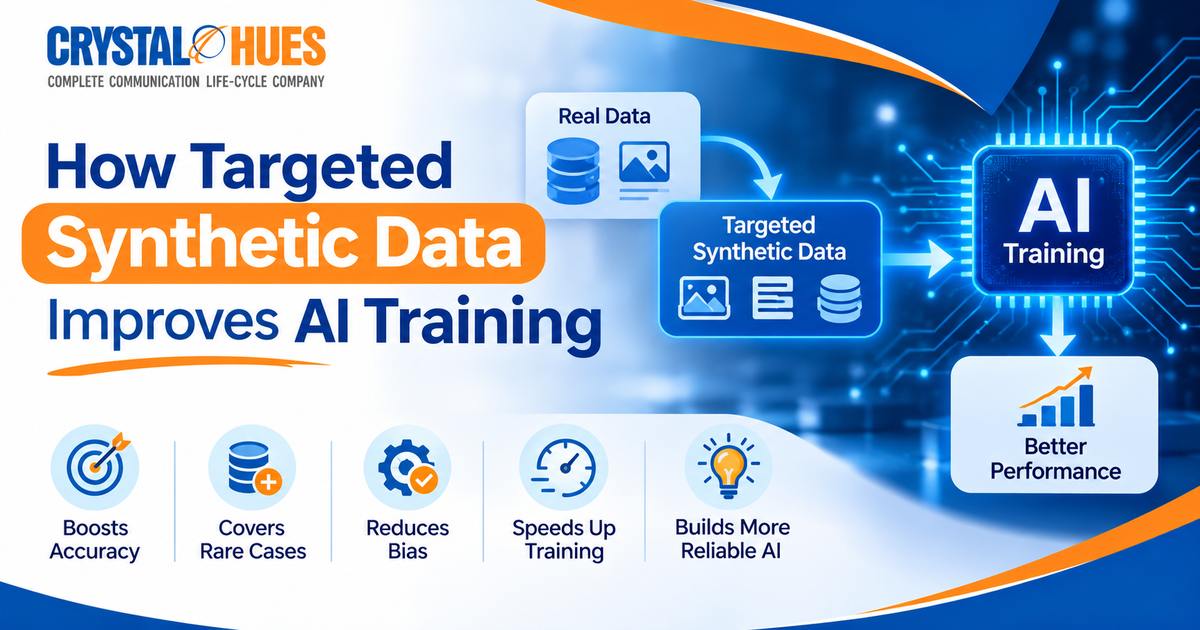
How Targeted Synthetic Data Improves AI Training
Introduction
Today, the race for AI
has intensified the dependence of LLM’s on large volumes of training data. The
quantitative aspect of data gets more attention than data quality and
diversity.
AI models are trained on increasingly large
datasets, but does more data always lead to better performance? Suppose your model needs more context around
your business, so you keep pushing more data into it which adds volume and
makes the datasets repetitive rather than teaching new patterns to models.
Targeted synthetic data can solve this issue, and we will be looking in the blog, how synthetic data improves multilingual AI models.
What is Synthetic Data?
Synthetic data is artificially generated
examples used to supplement an existing dataset. For multilingual AI, this can
mean generated text and speech samples in languages the corpus lacks, local
usage that differs from the standard form, industry conversations built around
real terminology, and speech patterns the model has not heard enough of.
A simple way to picture it is a torn piece of cloth. You do not replace the whole cloth. You patch the hole. Synthetic data works the same way. Its goal is to address specific gaps, not to add volume.
Why Synthetic Data matters for Multilingual AI?
A multilingual AI model handles different
languages and variations in how people communicate. The models that are trained
for multilingual outputs should have targeted synthetic data that is
contextually aware with domain specific terminologies and plug the gaps in
codeswitching and regional dialects.
Adding volume will not serve the purpose as the training should resemble the situations where the model struggle.
What Targeted Synthetic Data Fills Multilingual AI
Training Gaps
Consider a speech recognition model that
fails to translate accurate English Hindi conversations. A typical first order
thinking might include pushing more standard Hindi or English recordings in
model to learn patterns. But instead generate examples featuring natural mid
sentences to address specific gaps.
In this way synthetic data focuses on specific gaps with the relevant datasets as the shape and relevance of data matters.
Five Steps to
Generate and Evaluate Targeted Synthetic Data
Targeted synthetic data follows a clear
process, and the final step is what keeps it honest.
- Identify: Analyse model errors and
performance gaps to see exactly where the system fails.
- Define: Name the gap. Specify the
missing languages, patterns or scenarios.
- Generate: Create synthetic examples
that are relevant to that defined gap.
- Validate: Check the generated data
for accuracy, diversity and linguistic naturalness.
- Evaluate: Test the improvement
against unseen, real world data.
The process forms a loop. Evaluation results feed back into the next round of error analysis, so the model keeps improving in a measured way. Evaluation on unseen data is what closes the loop, because it shows whether the model got better in real conditions and not just on familiar examples.
Challenges of
Synthetic Data: Why Validation Matters
While we have discussed the role of
synthetic data, but its reliability and quality checks are essential before
generating examples for AI training. Let’s look at some challenges
1 Repetition
The examples generate may look similar
adding volume without adding any linguistic diversity.
2 Incorrect Terminology
It may contain wrong technical terms
affecting the reliability of domain specific training data.
3 Reinforced Bias
Generated data may come with bias leading
to imbalance in language representation.
4 Lack of Diversity
The examples may lack variation in accents,
expression and linguistic patterns.
The outputs of synthetic data should be reviewed for accuracy, diversity and repetition and technical and linguistic validation are essential quality checks that must be accounted for in the training dataset.
Real-World Data vs Synthetic Data: Why AI Needs Both.
A common misunderstanding is that synthetic
data can replace real data. It cannot, and it should not.
Real world data shows how people speak. It
carries natural variation, authentic speaker behaviour and representative usage
patterns. Synthetic data expands coverage. It provides targeted examples for
identified gaps, additional scenarios and controlled variations.
One proves that a pattern happens. The other makes it learnable. Real data brings credibility, while synthetic data brings coverage. Together they support both development and evaluation, and neither strand holds up alone.
What Good Synthetic Data Should Achieve
The value of synthetic data lies in whether
it helps an AI system perform better on data it has never seen. A well-designed
approach should help a model:
- Recognise accents and dialects the corpus underrepresented
- Handle conversations that switch languages mid-sentence
- Understand terminology specific to an industry or product
- Hold performance in situations it was not trained on
Frequently Asked Questions
Is synthetic data better than real data?
Comparison will be unfair as both serves
different purpose. Synthetic data fills gaps that real data fails to uncover.
How do you know if synthetic data works?
To check its working, we must use the model
on real world data and monitor its performance.
Why does multilingual AI struggle with
code switching?
Most datasets contain languages in
separate, clean form. Mixed language speech is underrepresented, so models
rarely learn it well.
Can synthetic data introduce bias?
Yes. It can show bias if the fed data is skewed. We must validate it to avoid the bias.
Conclusion
Quality in the datasets make a model perform
better and efficient. With the diffusion of AI in daily lives, the role of
accurate and quality data will become more prominent. Synthetic data will
unlock the connectivity in multilingual translation as markets become global
and the models will need context and examples that are specific and understands
nuances, so plugging the gaps across models and the data is important.
We at Crystal Hues support AI teams with data work that is built around purpose, from identifying gaps to linguistic validation across languages, dialects and domains. If your model is struggling with accents, code switching or industry terminology, we can help you build the right data and check it properly before training building trust across your models and services.