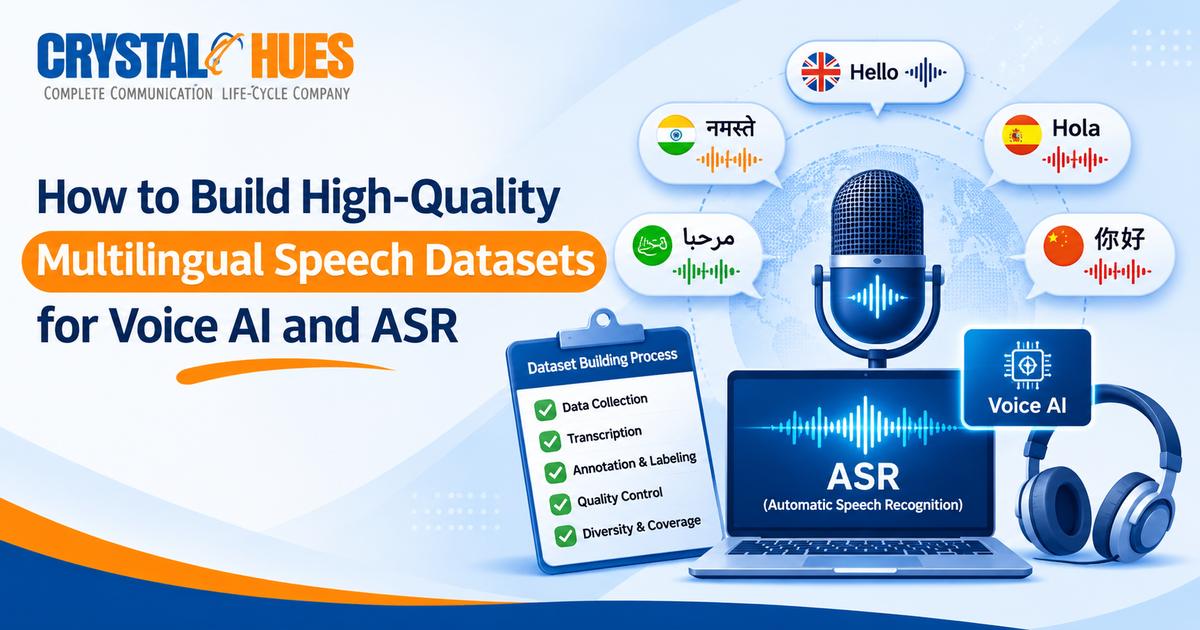
How to Build High-Quality Multilingual Speech Datasets for Voice AI and ASR
Introduction
40% of rural
Indian users rely on voice search to bypass typing and literacy barriers. The
number speaks volume about the adoption of Voice AI in a country with rural
population as large as India. Businesses should leverage this opportunity to create
high-quality multilingual speech datasets for Voice AI and ASR that
helps broadens their audience.
A speech model can only recognize the
voices it has learned from. If your training audio does not match the
languages, accents, devices and noisy rooms your users bring, accuracy drops
fast, no matter how many hours you collected. A useful dataset needs a clear
task scope, representative speaker and language coverage, consistent
transcription, audio-quality controls and proper consent and rights. This guide
walks through the full lifecycle of multilingual speech datasets: planning,
collection, transcription, annotation, validation and the mistakes to avoid.
What Is a Multilingual Speech Dataset?
A multilingual speech dataset is a
collection of audio recordings in more than one language, usually paired with
transcripts, timestamps, speaker details or other labels the task needs.
Datasets are normally split into three
parts. Training data teaches the model, validation data helps you tune it, and
test data measures how it performs on audio it has never seen. The test set
should be held out completely and should reflect the people and conditions you
expect in real use.
Different products need different data.
Automatic speech recognition (ASR), voice assistants and speech analytics all
use speech, but a call-center transcription tool and a smart-speaker assistant
will not need identical recordings.
Plan Language, Accent and Speaker Coverage
Start with your users, not with several
hours. List the target languages, locales, dialects, accents, age groups and
speaking styles your product will meet. Reading from a script sounds very
different from relaxed conversation, so decide which one you need.
Think about the details that trip up speech
models. Many speakers switch between languages mid-sentence. Names, places and
product terms are often missed. Domain vocabulary, such as medical or banking
terms, may barely appear in general speech data.
Then set inclusion and exclusion rules and
write down the gaps you already know about. If you could not record speakers
from a certain region, say so. A dataset should never be described as
representing an entire language community unless you have evidence for it.
Collect Audio Responsibly and Consistently
Good collection starts with a plan. Define
the recording prompts, the environments, the devices, the channels and the
audio formats, including technical settings such as sampling rate. A
phone-based voice product should be trained on phone-quality audio, not only
studio recordings.
Settle consent and rights before anyone
speaks. Participants should know how their voice will be used, and you need
clear usage rights, privacy controls, retention limits and rules on permitted
processing. These are far harder to fix after collection.
Use acoustic conditions that vary but still
match real use, such as quiet rooms, street noise or a car. Record metadata for
every file, including language, device and collection source, so you can trace
where each recording came from. If you need support at this stage, you can look
into AI data
collection options.
Transcription and Annotation Best Practices
Transcripts are only as useful as they are
consistent. Before work begins, write conventions for punctuation, hesitations
and false starts, numbers, code-switched words, names and audio that cannot be
understood. If one transcriber writes “twenty twenty-six” and another writes
“2026”, the model receives mixed signals.
Use qualified language reviewers and clear
annotation guidelines, plus a way to escalate ambiguous audio to someone who
can decide. Add timestamps, speaker labels or other annotations only when your
downstream task needs them, since every extra layer adds cost and room for
error.
Quality checks should be part of the workflow. Sample finished work, have reviewers check it, settle disagreements and track recurring error types so guidelines can be improved. Teams that need extra capacity often explore transcription services and AI data annotation and labelling to support this stage.
How to Validate Dataset Quality
Validation should happen before training,
not after problems appear. Start with the audio itself: look for clipping,
heavy noise, silence, duplicates and corrupted files. Then check that
transcripts line up with the audio and that metadata is complete and labels are
consistent.
Next, compare your language and speaker
distribution with the population you plan to serve. If one accent makes up most
of the data, you will see it in the results.
Keep training, validation and test splits
strictly separate. Guard against leakage, which happens when the same speaker
or the same recording shows up on both sides, making test results look better
than they really are.
Finally, evaluate ASR performance by language and by meaningful subgroup, such as accent or age group, and not only as one overall score. An average can hide a weak language. Teams building or testing recognition models may also review automatic speech recognition services as part of the wider workflow.
Common Mistakes to Avoid
Several errors appear again. Teams
over-represent one accent or speaker group, use inconsistent transcript rules,
ignore code-switching or overlook rights and consent. Others let duplicates or
leakage slip between data splits or rely only on automated checks that miss
meaning and context.
The simplest guard is to let your product’s real operating conditions guide dataset design. If users speak on busy streets in two languages, your data should include that.
How Crystal Hues Supports Speech and Language Data
Workflows
Crystal Hues offers services across the speech and language data workflow, including AI data collection, ASR, transcription and AI data annotation and labelling, all part of its wider AI data services. Review the relevant service pages to see how they fit your languages, data types and project needs. If you would like to discuss your requirements, get in touch with the Crystal Hues team.
Conclusion
The Voie AI market is going to increase multifolds. Businesses should take advantage of it and the one that provides quality multilingual speech dataset representing the rural masses of India that does business by sending text notes will come out as winners.
Frequently Asked Questions
What makes a good multilingual speech
dataset?
A good dataset includes defined scope, cultural context, local
dialects, accents and speakers.
How many hours of audio are needed to train an ASR model?
To put a number on it would be
unprofessional. It depends on the languages, the task, the model
approach and how varied the speakers and conditions are.
Why are accents and dialects important in speech data?
Accents and dialects cover the diversity of
languages in India. A model trained on a narrow range of voices tends to
perform worse for speakers outside it.
Should speech datasets include
transcripts and timestamps?
Speech datasets are needed for ASR
training. Timestamps, speaker labels and other annotations should be added only
if your task needs them.
How do you check the quality of speech
training data?
To check the quality of speech training data, check audio integrity, label consistency and metadata, then compare speaker with your target users. One should also keep test data separate and evaluate results by language and subgroup.