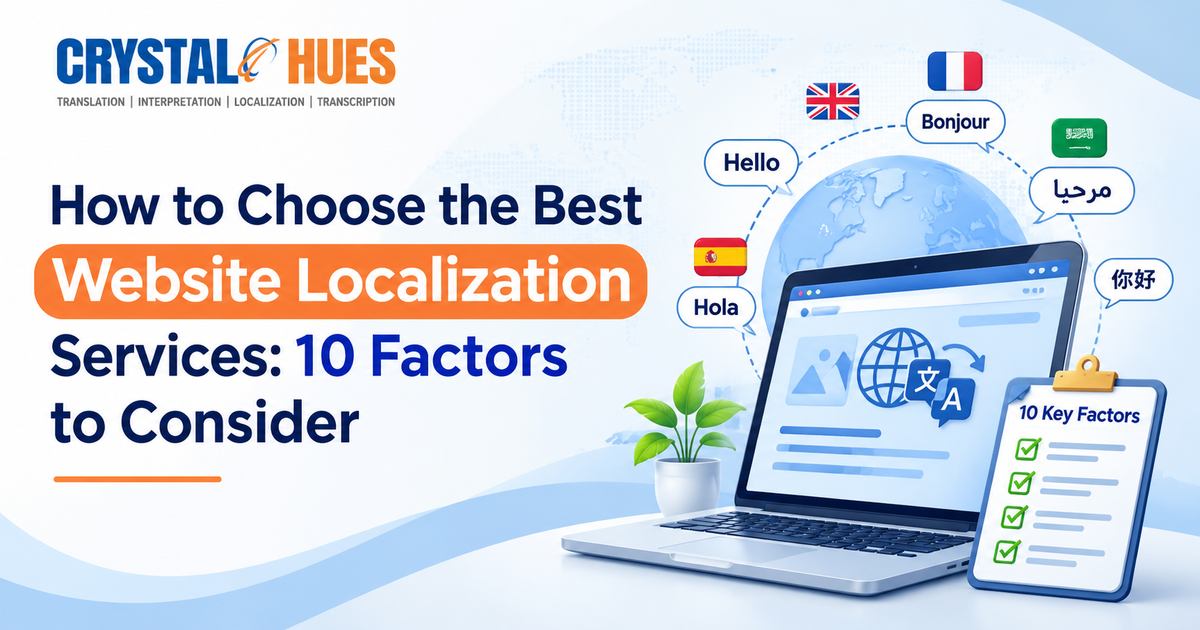
How to Choose the Best Website Localization Services: 10 Factors to Consider
Introduction
A website can be fully translated and still
feel foreign to the people reading it. Dates look wrong, buttons break,
examples do not fit and the tone feels slightly off. The best approach is to
judge a provider on language expertise, cultural adaptation, technical
delivery, quality assurance and ongoing support. This guide covers ten factors
to check, the questions to ask, common mistakes and the difference between
translation and localization. The right choice depends on your target markets,
website platform, content type and business goals.
What Do Website Localization Services Include?
Website localization means adapting your
site, so it feels natural to visitors in a specific market. Translation is one
part of it, but the work can reach well beyond words.
Depending on the project, it may cover website copy, user interface text, dates, currencies and units, images and cultural references, SEO elements, forms and user journeys. Not every project need all of these. A simple brochure site may only need careful copy and metadata, while an online store may also need local formats, payment details and tested checkout flows. Agreeing on scope early is the best way to compare providers fairly. Many businesses start by reviewing a provider’s wider localization services to see what is available.
10 Factors to Consider while choosing Localization Services
1. Language and Native-Market Expertise
Check that the provider covers your target
languages and understands regional usage. French for Canada and French for
France are not the same. Ask who will write and review your content, and
whether they are native speakers who live in or know the market.
2. Industry and Subject-Matter
Experience
A provider who knows your field will get
terminology and audience expectations right the first time. Ask whether they
have handled similar websites and request relevant examples instead of a
general client list.
3. Cultural Adaptation
Words are only part of the message. Ask how
images, tone, examples, product terms and calls to action are reviewed for each
market. A good provider will flag content that works in your home market but
may confuse or put off readers elsewhere.
4. Multilingual SEO Knowledge
Translated pages do not rank or get found
by default. Ask whether the provider considers local keyword research,
translated metadata, URL structure and international SEO needs. Make sure you
know whether this is included in the quote or handled separately.
5. CMS and Technical Workflow
Your content has to get in and out of your
website smoothly. Confirm that the provider can work with your CMS, file
formats, staging environment and handoff process. Clumsy exports and manual
copy-pasting are where delays and errors tend to creep in.
6. Localization Testing
Text that fits in English may overflow a
button in German. Ask how pages, navigation, forms, layouts, links and user
journeys are checked in context before launch. Reviewing a spreadsheet of
strings is not the same as seeing the live page.
7. Linguistic Quality Assurance
Quality should come from a clear process.
Look for review stages, style guides, terminology management and a defined way
to handle corrections. Ask what happens when your team disagrees with a choice,
and how that feedback is saved for next time.
8. Data Security
Localization incudes a large amount of source
data fed into the public domain. Make sure to check and regulate access points.
A reliable provider will maintain confidentially of your shared data.
9. Project Management and Scalability
Managing a project once its done is of utmost importance. Ensure you have named point of contact to handle any unforeseen errors and plans for scaling the process. A website will go through a lot of changes so a project manager will ensure its smooth operations.
10. Transparent Pricing and Scope
Ask for a breakdown that shows language pairs, content volume, engineering work, testing, revisions and any maintenance. Two quotes can look similar and cover very different things, so compare what is included, not just the total.
Questions to Ask a Website Localization Provider
Give every provider the same brief and the
same acceptance criteria, then compare their answers side by side. A simple way
to score them is to rate each of the ten factors from one to five and add the
totals.
Start with scope, then ask who reviews the target-language content and how they were qualified. Ask how changes in your CMS are handled and whether multilingual SEO is part of the work. Find out how defects are reported and fixed, and what happens when your source website changes after launch.
Website Translation vs. Website Localization: Which Do You
Need?
Website translation focuses on rendering
your content in another language accurately. Website localization goes further
and adapts the wider experience for a target market, including formats,
visuals, tone, search needs and how people move through the site. The two terms
are related, but they are not interchangeable.
Many projects need one or a mix of both. If your audience already understands your brand and you only need accurate language, translation may be enough. If you are entering a new market and want the site to feel local, broader localization makes sense. Some teams start with website translation services and add localization in stages as the market grows.
Common Mistakes to Avoid When Selecting a Provider
The most common mistake is choosing on price alone, which often leads to rework later. Others include skipping native-market review, assuming translation automatically includes SEO, and launching without testing pages in context. Many teams also forget to plan for content updates, so the translated site slowly falls out of date. Finally, agree early on who gives the final approval for each language.
Why Consider Crystal Hues for Website Localization?
Crystal Hues offers localization services and website translation to help businesses reach audiences in different languages. If your project also needs wider multilingual support, you can explore our professional language services.
Frequently Asked Questions
What is included in website localization
services?
Website Localization can include website copy, interface text, formats, images,
metadata, SEO elements and testing.
What is the difference between website
translation and localization?
Translation converts text from one language to another while Localization
adapts the wider experience, such as formats, visuals, tone and user journeys,
for a specific market.
How do I choose a website localization
company?
Choosing a website localization company
requires defining your markets, scope and the language expertise you need.
Does website localization include
multilingual SEO?
Yes, it might include multilingual SEO.
How much do website localization
services cost?
The cost depends on requirements, so ask for a quote and make informed choices.
Conclusion
Localization is a vast industry which can
decide the fate of a company, so before choosing, consider the factors we discussed
in this blog. The audiences are getting smart and they need localized
experiences without compromising on quality. With AI diffusing the businesses, you
need to think fast on feet and evolve their workflow.
Before you request proposals, define your
target markets, scope and acceptance criteria so every provider quotes on the
same terms. When you are ready, you can request a
localization quote or talk to the Crystal Hues team about your website.