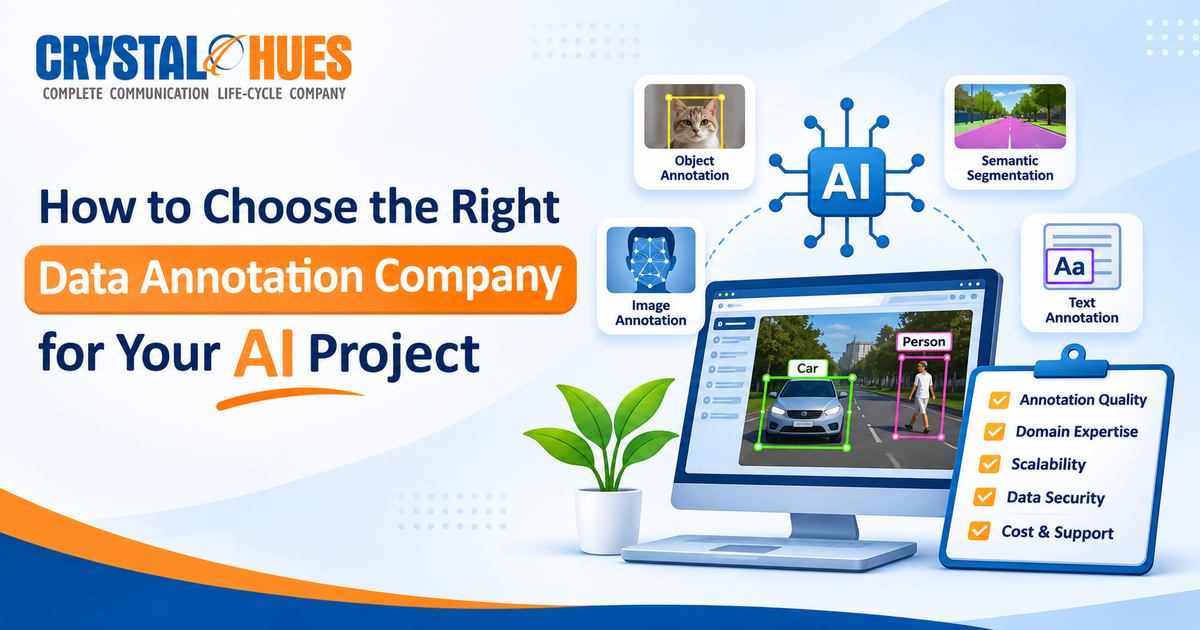
How to Choose the Right Data Annotation Company for Your AI Project
Introduction
Today models run on data. The efficiency of
models is a function of quality of labelled data it is fed up with. If labels
are inconsistent, unclear or wrong, the model picks up those errors, and fixing
them later costs far more than getting them right at the start. So, if you are
wondering how to choose a data annotation company, look at task and domain fit,
annotation process, measurable quality checks, data protection, scalability and
communication, and not at price alone.
What Does a Data Annotation Company Do?
A data annotation company adds structured
information to raw data so it can be used for model training, evaluation or
analysis. This can mean labels, tags, classifications, transcriptions, bounding
boxes around objects, segmentation masks or entity tags in text.
The work can cover images, video, text, audio, speech and structured data, depending on what a provider can deliver. Many AI teams work with a provider that can support several of these stages through wider AI data services.
Factors to Consider When Choosing a Data
Annotation Company
1.Domain and Task Expertise
Always check whether the provider has real
experience with your data type, label structure, language and subject area.
Labelling street scenes, medical notes and call-centre audio are very different
tasks. Ask how they handle edge cases, such as blurry objects, sarcasm in text
or overlapping speakers, since this is where weak annotation usually shows up.
2. Annotation Guidelines and Onboarding
Guidelines are the written rules that tell annotators exactly how to label each case. Ask how they are created, tested, updated and shared with the team. Also ask what happens when an annotator meets an unclear example.
3. Quality Assurance
Look for layered review, where one person
labels and another checks. Ask about sampling, how disagreements are settled
(often called adjudication), how errors are categorized and how rework is
handled. Some projects also measure inter-annotator agreement, which shows how
often different annotators label the same item the same way.
4. Data Security
You may be sharing sensitive images,
recordings or customer text. Ask about access controls, confidentiality terms,
secure file transfer, how long data is kept, how it is deleted and where it can
be processed. If a provider mentions a certification, ask for proof. A reliable
partner will explain clearly who sees your data and what happens to it
afterward.
5. Scalability and Workforce Management
Your volume may grow, or you may need new
languages or specialist reviewers later. Ask how the provider adds capacity,
trains new annotators and keeps quality steady when the workload jumps. There
is often a trade-off between deep specialist skill and large scale, so be clear
about which matters more for your project.
6. Tools, Workflow and Reporting
Check which file formats and label formats
the provider supports, and how finished data will be delivered. Ask whether you
will get progress dashboards, version history and audit trails. Do not assume a
specific tool or platform is included. If you need the output to fit into your
own pipeline, say so early.
7. Communication, Timelines and Total
Cost
Ask who owns your project day to day, how change requests are handled and what service levels apply. On cost, look at pricing units, pilot fees, rework terms and any dependencies. The cheapest unit price is not always the cheapest project, since rework, delays and your own team’s review time all add up.
Questions to Ask Before Hiring a Data
Annotation Provider
Use the same questions with every provider
so their answers are easy to compare. Can you complete a representative pilot
on our data? How are annotators trained for this task? Who reviews difficult
labels? Which quality metrics will you report to us? How is sensitive data
handled? Can you work with our formats and label structure? How are changes to
the guidelines managed? What exactly is included in the quote?
Do not rely only on a sales presentation.
Ask for anonymized sample outputs, process documents and a clearly scoped
pilot.
Red Flags to Watch For
Some warning signs show up early. Be
careful if a provider gives vague answers about quality checks, promises
accuracy with no explanation of how it is measured, or has no documented
process for guidelines. Unclear data handling, an unwillingness to run a pilot,
pricing that is hard to understand and timelines that seem too good to be true
are also worth questioning. So is the lack of a named person to escalate
problems to.
Compare scope and acceptance criteria, not
only the unit price. Good data quality
assurance is part of the work, not an optional extra.
How to Compare Providers: A Simple
Evaluation Scorecard
A scorecard keeps the decision fair,
especially when several people are involved. For each provider, rate every
criterion from 1 to 5 based on what you actually saw in the pilot and the
answers you received. These ratings are your own judgment, not industry
benchmarks, and there is no universal pass mark.
Start with domain fit and pilot quality.
Check whether the provider has experience with your data type, labels and
language, and how well they performed on a sample of your own data. Then look
at quality assurance transparency, meaning the review layers, error tracking
and rework process they described. Security comes next: ask about access,
transfer, retention and deletion practices.
Then rate scalability, which is the
provider’s ability to add volume, languages and reviewers. Workflow and
reporting cover the formats they support, dashboards and version history.
Communication covers whether you have a named owner, a clear escalation path
and a defined way to handle changes. Finally, rate total cost by looking at
what the quote includes, the rework terms and the pilot cost.
How Crystal Hues Supports AI Data
Annotation & Labelling
Crystal Hues
lists AI
data annotation and labelling services as part of its wider AI data
services, alongside areas such as AI data collection
and sourcing and AI data
cleaning and preprocessing. You can review the service page to see how it
fits your data type and project needs and use the questions and scorecard above
to assess us the same way you would any other provider. If you would like to
discuss your requirements or request a quote, the Crystal Hues team is
happy to talk.
Frequently Asked Questions
What should I look for in a data
annotation company?
You should look for domain experience,
transparency in process and past proof of work.
How do data annotation companies ensure quality?
To ensure quality, data annotation
companies use mix of clear guidelines, layered review, annotator training and
timely delivery of work.
Should I run a pilot before choosing a
data annotation provider?
Yes, a pilot would help catch preliminary errors handling edge cases before committing to a larger project.
How much do data annotation services cost?
Data annotation services cost depends on task complexity, requirements and provider’s capabilities.
Can one provider handle image, text, audio and video annotation?
Yes, we at Crystal Hues handle all types of annotation. If you want, look at our in providing data augmentation services where we label your data with accuracy..