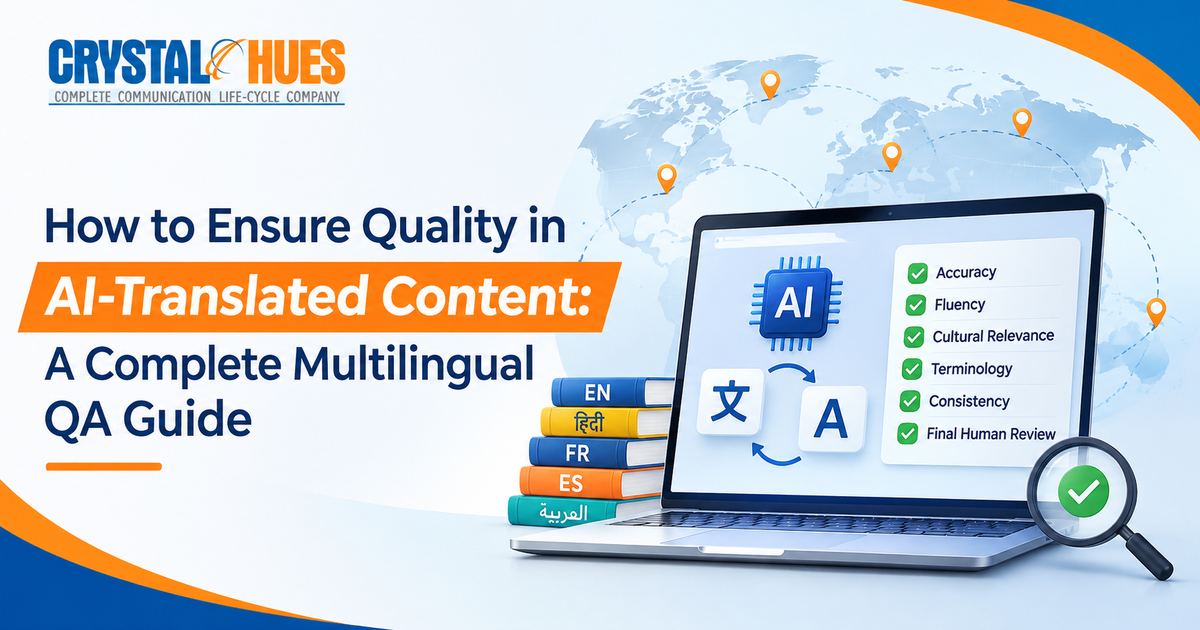
How to Ensure Quality in AI-Translated Content: A Complete Multilingual QA Guide
Introduction
Quality is the hallmark of any product. A
plethora of AI -translated content is floating used by people, models and
businesses. If left unchecked, it
undermines the quality of content lacking originality and fails to convince the
users.
AI translation can produce text that reads
smoothly and is still wrong. A dosage may change, a “not” may disappear, a
product name may be translated when it should not be, or a formal customer
message may come out sounding casual. Fluency hides these errors, which is why
they slip through. Reliable AI translation quality assurance combines
risk-based review, terminology and style controls, automated checks and
qualified human assessment.
What Is AI Translation Quality Assurance?
AI translation quality assurance is a set
of checks that confirm translated content meets its purpose, audience,
language, accuracy and compliance needs. It applies to machine translation and
other AI-generated translation alike.
It is different from functional
localization testing. Linguistic QA looks at the words: meaning, terminology,
grammar and tone. Functional testing looks at how content behaves on screen,
such as text truncation, broken links, formatting and display problems. Both
matter, and they are often done by different people.
Quality criteria also change with the
content. A marketing tagline needs brand voice and cultural fit. A legal clause
or medical instruction needs precision above all. A low-risk help article may
only need a light check.
What Should You Check in AI-Translated Content?
Meaning and completeness. Look for omissions, additions, mistranslations, missed negation and
changed facts. These are the most serious errors because they alter what the
reader understands.
Terminology.
Check that approved product, technical, legal or industry terms are used, and
used the same way across every asset. Terminology management, meaning a
maintained glossary of approved terms, makes this repeatable.
Grammar, fluency and readability. The text should read naturally without drifting from the source
meaning.
Tone and brand voice. Check formality, audience fit and cultural suitability against your
style guide. A friendly tone that works in one market can feel disrespectful in
another.
Locale and formatting. Verify dates, numbers, currencies, units, punctuation, names and
layout. “03/04” can mean March or April depending on the country.
Risk and compliance. Flag sensitive claims, regulated terminology and privacy issues,
and require specialist review for high-impact content.
A Step-by-Step Multilingual QA Workflow
First, classify content by risk, purpose
and audience, since this decides how much review it needs. Second, prepare the
source text, terminology and style guidance, because unclear source writing
produces unclear translation. Third, choose the machine translation or AI
workflow and record its settings and version so results can be traced later.
Fourth, run automated checks for terminology, consistency, formatting and known
error patterns. Fifth, add human review at a level that fits the risk, with
domain specialists for sensitive material. Sixth, categorize errors, correct
the content and feed recurring issues back into your guidelines and workflow.
Seventh, sample live content regularly and refresh your QA criteria as models
and content change.
AI Translation QA vs. MTPE vs. Proofreading
All the three terms look same and overlap
but they are used for different purpose.
AI Translation QA is the umbrella term handling overall quality-control process. It
includes automated checks and human review to ensure accuracy and smooth translation.
A rigorous testing helps find errors and is suited to manage quality across a
whole content program.
MTPE handles
all post editing translation where a linguist edits machine-translated text to
correct errors and improve quality. It works best for content where the machine
output is a good starting point and needs refinement, not a rewrite.
Once the final content is prepared, a
narrower review of language, vocabulary and presentation is done in form of proofreading.
It finds its usage in polishing an already checked or accurate document.
All three are necessary steps and must be
used according to the scope of work.
Choose between them based on source
quality, content risk, intended use and the level of accountability you need. A
sensitive document may need full human translation or heavy machine
translation post-editing, while a simple internal update may only need
light editing and a final check from proofreading
services.
How to Measure Translation Quality
Measure quality with specific, repeatable
signals. These include error categories and their severity, terminology
compliance, completeness, reviewer acceptance and task-specific linguistic
assessment. A severity scale helps because a wrong dose and a missing comma
should not carry equal weight.
Automated metrics can help compare outputs
or track trends, but they often miss context, brand voice and high-impact
meaning errors. Use them as one input.
Avoid universal pass scores. A threshold
only makes sense when a client or project has formally defined it, because
acceptable quality for a social post is not acceptable for a contract.
Common AI Translation QA Mistakes
The most common mistake is relying on
fluency alone. Others include skipping domain review, using inconsistent
terminology, applying identical QA to all content, ignoring locale formatting
and assuming AI output is automatically accurate or safe. Each one comes from
treating translation as finished when the machine stops, and not when the
content has been checked for its real purpose.
How Crystal Hues Supports Translation Review and
Post-Editing
Crystal Hues offers translation
services, localization
services, post-editing, MTPE services
and proofreading. These can support the review stages described above, from
editing machine output to checking final language quality. Review the service
pages to see how they fit your languages and content types and talk to the
Crystal Hues team about your requirements.
Conclusion
AI has made translation faster and more
affordable, and businesses now produce multilingual content at a scale that was
hard to imagine a few years ago. Speed alone does not create trust, though. A
single wrong term or missed negation can confuse customers, create compliance
risk or damage a brand in a new market.
The answer is a structured approach to
quality. We should classify content by
risk, set terminology and style rules, combine automated checks with qualified
human review and track errors so the process keeps improving.
If you are scaling AI translation, choose a partner that brings professionalism and a clear review framework. Explore Crystal Hues’ machine translation post-editing and translation services, or talk to our team about your multilingual QA needs.
Frequently Asked Questions
How do you check the quality of AI
translation?
We check quality by running periodic checks,
classifying the content by risk and ensuring correct formatting and terminology.
Is AI translation accurate enough for business content?
AI Translation alone is prone to hallucinations
so a human review before use works for high-risk material.
What is the difference between MTPE and
proofreading?
MTPE fixes errors and is a broad review of
the content, but proofreading is a narrower version for language or presentation
issues usually on text that is already largely accurate.
Should all AI-translated content be reviewed by a human?
Yes, it should be reviewed with different
risk content requiring different checks.
How do you choose a QA process for legal or medical translation?
While choosing a QA process we should use specialist reviewers with subject knowledge, strict terminology control and formal error severity rules.