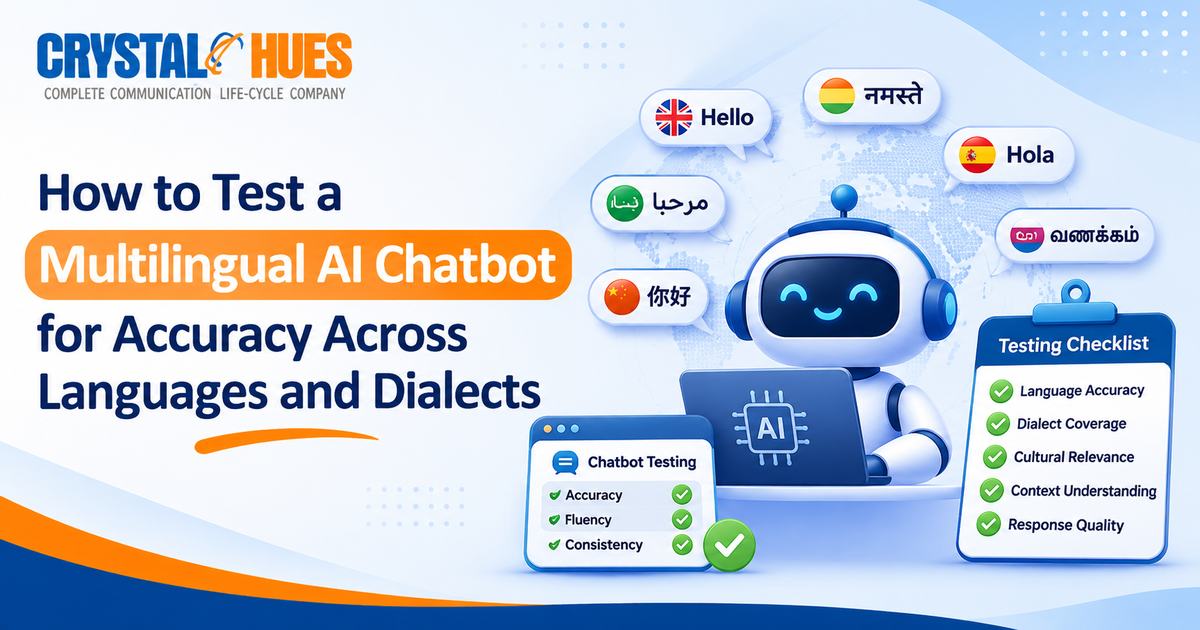
How to Test a Multilingual AI Chatbot for Accuracy Across Languages and Dialects
Introduction
Multilingual AI chatbots reflect the diversity of languages an audience speaks in a specific location. A chatbot that works well in English can fail badly in Hindi, Arabic or Spanish. Language variation, regional dialects, mixed-language messages and domain vocabulary all change how users write and what they expect back. The best approach to multilingual chatbot testing is to evaluate language understanding, intent and entity accuracy, response relevance, safety, consistency and real-user scenarios separately for each target language. This guide explains what to test, how to build a test dataset, a repeatable workflow, the metrics that matter and the failures to look for.
What Is Multilingual AI Chatbot
Testing?
Multilingual chatbot testing is a
structured evaluation of how well a chatbot understands user input and how good
its answers are across your target languages and locales.
A response can be grammatically perfect and
still misread the user’s intent or give a wrong answer. Testing needs to cover
whether the chatbot understood the question, answered it correctly and helped
the user finish what they came to do.
How you design the tests should depend on
your use case and risk level. A retail chatbot answering delivery questions
needs a different test plan from one handling banking or health queries, where
a wrong answer costs far more.
What Should You Test Across
Languages and Dialects?
Test each area below separately for every
language and locale you support.
Language and locale coverage. Check scripts, spelling variants, regional vocabulary and local
formats for dates, numbers, currencies and addresses.
Intent recognition and entity
extraction. Intent recognition is whether the bot
identifies what the user wants. Entity extraction is whether it picks out
names, dates, products and domain terms correctly. Both can drop sharply in
languages with less training data.
Dialects, code-switching and
transliterated input. Real users mix languages in
one sentence, which is called code-switching. They also type one language in
another script, such as Hindi written in Roman letters, and use slang and
informal spellings. Your tests should include these.
Response quality. Look at relevance, completeness, fluency, tone and whether answers
stay consistent with your approved knowledge sources. Watch for hallucination,
where the bot states something confident that is not true.
Safety and cultural context. Check for harmful or biased outputs, sensitive topics, phrasing
that may be inappropriate in each culture and how the bot hands over to a human
when it should.
Task completion. A plausible sentence is not success. Test whether the user can
finish the journey, such as tracking an order or booking an appointment.
How to Build a Multilingual
Chatbot Test Dataset
A good test dataset decides how reliable
your results are. Start by creating representative prompts for each language,
locale, dialect and user group. Include common questions, ambiguous ones, rare
ones and adversarial ones designed to confuse the bot.
Use native or qualified language reviewers
to confirm that prompts sound natural, mean what they should and have a clear
expected outcome. Be careful with machine-translated prompts. They are quick to
produce, but they rarely match how real people write, so they should not
replace naturally written user language.
Before testing begins, define your labels
and scoring guidance. Keep examples of responses that count as acceptable,
partially correct and incorrect so every reviewer scores the same way. Building
and labelling this data is a specialist task, and teams often look at AI
data services to help prepare it.
A Step-by-Step Evaluation Workflow
Use the same process every time so results
stay comparable.
First, define your use cases, target
locales and risk categories. Second, build a representative test set with
reference answers or scoring rubrics. Third, test intent, entities, response
quality, safety and task completion. Fourth, combine automated checks with
human review, since automation is fast, but people are better at judging
nuance, tone and cultural fit. Fifth, group the errors by type, prioritize
fixes and retest after any change to the model, prompts or knowledge base.
Sixth, monitor real user feedback in production and refresh the test set as
user behaviour changes.
Treat this as a cycle, not a one-time
launch check. Chatbots change, and so do the ways people talk to them.
Metrics and Common Failure
Patterns
Choose measures that suit the task. Common
ones include intent accuracy, entity-level precision and recall, task
completion rate, response relevance and human-rated linguistic quality.
Precision shows how many of the bot’s answers were correct, and recall shows
how many of the correct answers it found.
No single score captures multilingual
performance. Report results separately by language, locale and use case,
because a healthy overall number can hide a weak language.
Common failures to look for include literal
translation that sounds unnatural, wrong regional terms, missed negation (such
as “do not cancel” understood as “cancel”), incorrect entities, confusion when
languages are mixed and a tone that feels rude or too casual for the culture.
Semantic labelling of test data, such as semantic annotation, can help teams mark
meaning, entities and intent consistently when building test sets.
How Crystal Hues Can Support
Multilingual AI Evaluation
Crystal Hues offers NLP services, AI testing and feedback and semantic annotation, alongside its wider AI data services. These can be relevant when you need language data, linguistic review or structured feedback for chatbot evaluation. Review each service page to see how it matches your languages and use case and talk to the Crystal Hues team to discuss what your project needs.
Conclusion
Multilingual chatbots are in growing demand as markets become more connected
and businesses serve customers in more than one language. Users expect answers
that are accurate, timely and true to what they asked, whichever language they
write in. A chatbot that only works well in one language can quickly lose their
trust in the others.
Reaching that standard takes a careful approach built on checks and balances.
Test each language and locale separately, and include dialects, mixed-language
messages and informal spelling in your test sets. Combine automated checks with
native speaker review so that meaning, tone and cultural context are judged by
people who know them.
Frequently Asked
Questions
How
do you test an AI chatbot in multiple languages?
We build a unique test set with score intent, response quality and automated
checks for all languages.
What
is the difference between chatbot translation testing and multilingual chatbot
testing?
The major difference lies in the purpose. Translation testing checks whether text is rendered correctly in another language. Multilingual chatbot testing checks whether the bot understands users and gives correct, useful answers in that language.
How
can dialects and code-switching be evaluated?
To properly evaluate dialects, we should include realistic prompts using
regional vocabulary and use informal or transliterated spelling. Have native
reviewers confirm what each prompt means and what a good answer looks like.
Which
metrics are useful for multilingual chatbot evaluation?
Metrics like task completion, entity precision, response relevance and human
rated language quality are useful for multilingual chatbot evaluation.
How
often should multilingual chatbot tests be updated?
Whenever we change the model, prompts or knowledge base, we should refresh the
tests for chatbots.