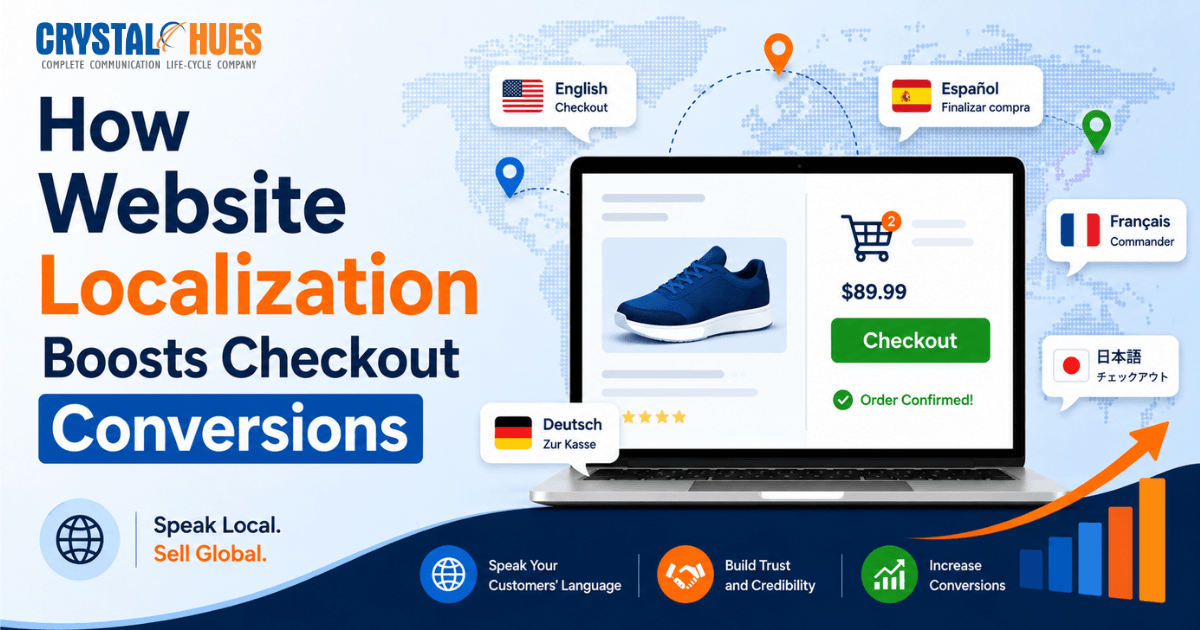
How Website Localization Boosts Checkout Conversions
Navigating the Checkout Conundrum
A global fashion brand launches its website in eight languages. Every product page reads correctly. Every button and label has been translated by native linguists, and the team is ready to celebrate.
Then the data comes in. Traffic is climbing
steadily across new markets. But checkout completion is falling sharply in Germany and Spain. Nothing on the site looks broken. No errors appear.
Customers simply stop halfway through paying and leave.
A classic blind spot in global ecommerce
expansion. Companies treat translation as the finish line, when it is just the
starting point.
Translation Solves Words, Not Experience
A QA team investigated the German and
Spanish checkout flow. The issues were not linguistic. They were experiential.
The currency symbol was displayed in the
wrong position. A button label wrapped onto two lines because the translated
text ran longer than the original. The date format did not match local
convention, creating confusion about delivery timelines. Form fields mixed
languages inconsistently, making the page feel foreign despite accurate
wording.
None of these are translation mistakes.
They live in the gap between "technically accurate" and
"genuinely usable." That gap is exactly where localization QA
operates.
Small Frictions, Big Consequences
Customers rarely register a misaligned
currency symbol as a conscious thought. What they feel instead is a flicker of
doubt, right now they are about to hand over payment details.
That doubt is often enough to abandon the
cart.
This is why experienced global brands ask
two separate questions when entering a new market. First, has the content been
translated accurately? Second, has the entire experience been validated for
that market's formatting, layout, and expectations?
Skipping the second question is how
companies end up with strong language coverage and weak conversion numbers.
Checkout Is Where Trust Is Tested
Ecommerce checkout is the most sensitive
part of any website journey. It is the exact point where a browsing customer
becomes a paying one, and trust is tested most directly.
A shopper who has browsed comfortably in
their own language will still hesitate if the payment page suddenly feels
inconsistent. A form field that does not match local naming conventions, an odd
phone number format, or a wrong decimal separator can each raise a quiet red
flag.
That red flag says: this page was not
really built for me.
Why Localization QA Gets Overlooked
Many businesses assume translation marks
the end of localization work. Localization QA is where the value of that
translation is protected or lost.
It means testing the interface the way a
real user in that market would experience it. Layout, formatting, cultural
convention, and functional flow all get reviewed together, not in isolation.
This step is what separates a website that
speaks the local language from one that feels local.
How Crystal Hues Approaches This
At Crystal Hues, translation
accuracy is treated as only one layer of a larger process. Equal weight goes to
validating how translated content behaves inside real interfaces and real user
journeys, in the market context it will be used in.
A checkout page, an app screen, or a signup
form can each pass a translation review and still fail a usability review.
Formatting and cultural context need the same rigour as language itself.
This is the layer that most localization
projects skip, and the one that quietly determines whether a launch succeeds.
If
you are looking to make your multilingual content truly market ready, explore Crystal
Hues' translation
solutions and discover how we help businesses deliver experiences that
resonate across languages and cultures.
What the Fix Actually Looks Like
The fix is rarely dramatic. It usually
involves updating layouts to accommodate translated text length, correcting
local currency and date formats, and validating every checkout flow end to end.
The difference this makes is significant. A
page that once felt translated starts to feel native. Customers stop noticing
the interface and start focusing on the product, which is exactly the
experience a global brand should be aiming for.
The Bigger Lesson for Global Brands
Localization is a discipline that treats language, layout, and user experience as
one connected system.
A website can have flawless grammar in
every language and still lose customers if the experience underneath does not
match local expectations. Success in one area cannot make up for failure in
another.
Companies that understand this treat
localization QA as a standard part of their launch process. They do not wait
for falling conversion numbers to trigger a fix. Testing the full user journey,
not just the copy, is what protects revenue and builds lasting trust.
Conclusion
Users are at the forefront of products and
translation. Localization ensures a seamless user experience removing friction
points from the customer’s buying journey. Getting the language right earns
attention. Getting the experience right earns the sale. For any business
expanding into new markets, that distinction is worth building into the launch
process from day one, not discovering after checkout numbers start to slip.