Languages Spoken in New Zealand
Languages Spoken in New Zealand: English, Māori, and a World in Between
New Zealand is a small country with a surprisingly complicated relationship with language. Three official languages. Over 160 spoken across its cities. A history that includes deliberate suppression, hard-won revival, and an ongoing negotiation between who New Zealanders have been and who they are becoming.
For anyone working across borders — in translation, education, healthcare, business, or policy — understanding this landscape is not optional. It shapes how you communicate, how you localise, and how seriously your audience takes you.
What Languages Are Officially Recognised in New Zealand?
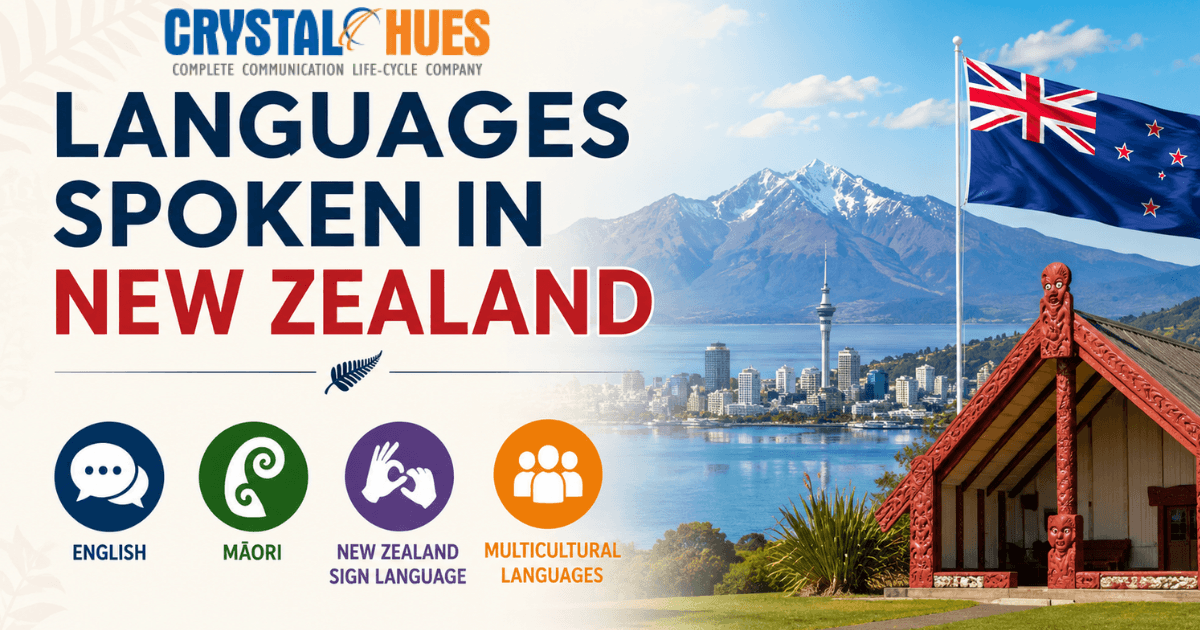
New Zealand is one of a small group of countries with three official languages: English, Te Reo Māori, and New Zealand Sign Language (NZSL).
Each earned its official status at a different moment in history, and each reflects a different conversation about belonging.
English came first, practically speaking. It arrived with British settlers in the 19th century and embedded itself into every institution — courts, schools, newspapers, commerce. It was never formally legislated as official in the early years; it simply dominated. Today, English is the working language of government, media, and business, and is spoken by the overwhelming majority of the population.
Te Reo Māori was recognised under the Māori Language Act of 1987. That recognition came late — and it came only because communities fought for it. For much of the 20th century, Māori children were punished for speaking their own language in school. The damage was real and generational. The 1987 Act was a turning point, but it was the grassroots kōhanga reo (language nest) movement a few years earlier that had already started pulling the language back from the edge. Today, Te Reo is on road signs, in government documents, on national television, and woven into everyday New Zealand speech in ways that would have been radical fifty years ago.
New Zealand Sign Language became official in 2006. This made New Zealand one of the very few countries in the world to grant a sign language full official status — an acknowledgment that the deaf community's language is not a workaround or an accommodation, but a language in its own right, with its own grammar, regional variation, and cultural weight.
How Widely Is Te Reo Māori Spoken?
Around 185,000 to 200,000 people in New Zealand can hold a conversation in Te Reo Māori. That is roughly 20 to 25 percent of the Māori population — and the numbers are moving upward.
The regions with the highest concentration of fluent speakers tend to be Northland, the East Coast, and parts of Waikato. But the revival is not just geographic. It is generational. Young New Zealanders — Māori and Pākehā alike — are enrolling in language courses, downloading apps, and choosing kura kaupapa Māori (Māori-medium schools) for their children in growing numbers.
Government strategy has formalised this push. Targets exist for increasing the number of proficient speakers over the coming decades, and Crown agencies are now expected to demonstrate genuine engagement with the language, not token inclusion.
What makes Te Reo Māori distinct — and demanding for translation professionals — is that it is not just a vehicle for information. It carries concepts that have no clean English equivalent. Whakapapa is not simply genealogy; it is a framework for understanding the world through connection and descent. Tikanga is not just custom; it is the right way of doing things according to values that predate European arrival. Mana carries dimensions of prestige, authority, and spiritual weight that a single translated word will never fully convey. This is precisely why culturally informed translation matters more than technical fluency alone.
What Other Languages Are Spoken Across New Zealand?
Walk through central Auckland on any given day and you will hear Mandarin, Samoan, Hindi, Tongan, Tagalog, Korean, and probably a dozen more languages before lunchtime. Auckland is, by some measures, one of the most linguistically diverse cities in the Southern Hemisphere.
Samoan is the most widely spoken Pacific language in the country. The Samoan community has been part of New Zealand's social fabric for decades, with deep roots in South Auckland in particular. Tongan, Cook Islands Māori, and Niuean follow — languages that are related to Te Reo Māori in some respects but distinct enough to require their own translation and interpretation resources.
Mandarin and Cantonese have grown significantly over the past thirty years, driven by immigration from China, Hong Kong, and Taiwan. Hindi and Punjabi reflect a large and established South Asian community. The Filipino community has expanded quickly in recent years, making Tagalog an increasingly common language in schools, hospitals, and workplaces. Afrikaans, French, Korean, and Japanese also appear consistently in census data.
In total, New Zealand's census regularly records over 160 languages spoken in people's homes. This is not a footnote. It is the reality of what New Zealand actually sounds like.
Why Does This Matter for Translation and Localisation?
It matters because language is never just words on a page.
When a healthcare provider needs to communicate a diagnosis or a treatment plan to a patient whose first language is Samoan or Punjabi, accuracy is the minimum requirement. Cultural appropriateness is the standard. A medically correct sentence that carries the wrong register, or that misses a cultural nuance around family decision-making or spiritual belief, can break the communication entirely.
When a business wants to connect with New Zealand's Māori population, it cannot simply translate its English content into Te Reo and consider the job done. The values embedded in Māori communication — reciprocity, collectivity, relationship before transaction — shape how messages are received. Getting that wrong is not just ineffective. In some contexts, it causes real offence.
Even New Zealand English deserves attention in localisation work. It follows British spelling conventions — colour, organise, centre — but the tone is distinctly its own: informal, understated, and quick to reject anything that sounds preachy or overblown. International brands that import their UK or US tone wholesale often land awkwardly. New Zealanders notice.
Is Te Reo Māori Growing or Disappearing?
It is growing — but the question itself tells you something about how close the language came to being lost.
By the 1970s, there were genuine fears among Māori elders that their grandchildren might never speak the language. The suppression of decades had done serious damage. What changed the trajectory was not a government programme but a community decision: to create spaces where children could grow up hearing and speaking Te Reo from birth.
The kōhanga reo movement, which began in 1982, created that space. Kura kaupapa Māori extended it through school years. A dedicated Māori television channel and radio stations have given it a media presence. Today, Te Reo Māori is heard not just in classrooms or ceremonial contexts but in workplaces, on podcasts, and in casual conversations between people who want to use it.
The language is not out of danger. But it is no longer fading.
New Zealand's Languages in Brief
New Zealand's linguistic identity is built on three pillars — English, Te Reo Māori, and New Zealand Sign Language — and filled in by over 160 community languages that reflect where its people have come from. Each of these languages represents a community with real communication needs: in healthcare, in legal settings, in education, in commerce.
Working across these languages effectively demands more than translation. It demands cultural understanding, contextual knowledge, and professionals who treat language as a living thing rather than a conversion exercise.
Frequently Asked Questions
What is the most widely spoken language in New Zealand?
English is the most widely spoken language and is used across government, business, education, and daily life by the great majority of New Zealanders.
How many official languages does New Zealand have?
Three — English, Te Reo Māori, and New Zealand Sign Language.
When was Te Reo Māori made an official language?
Te Reo Māori was officially recognised under the Māori Language Act in 1987.
What are the most common migrant languages in New Zealand?
Samoan, Mandarin, Hindi, Cantonese, Tagalog, Tongan, Punjabi, Korean, and Afrikaans are among the most widely spoken migrant languages.
Why was New Zealand Sign Language made official?
NZSL was recognised in 2006 to affirm the rights of the deaf community and acknowledge sign language as a full and distinct language rather than a secondary communication method.