Most Spoken Languages in Dubai
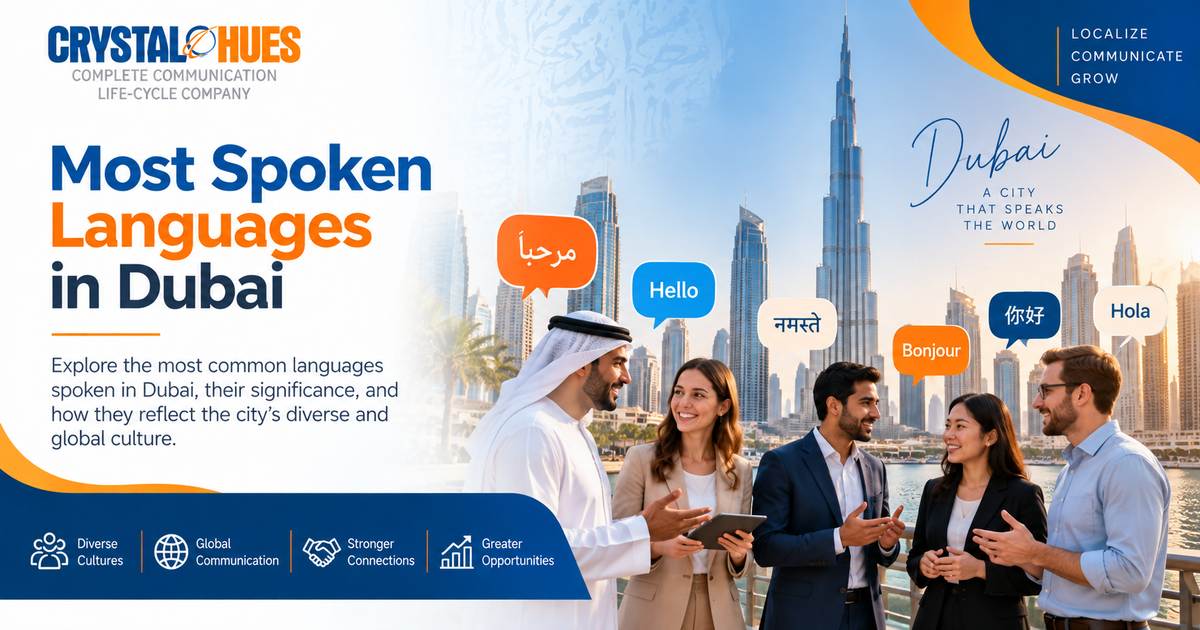
Dubai is the melting pot of the world. Take
a look at this vibrant city and you will find a wide variation of languages. English
blends with Tagalog. Urdu flows into Malayalam. This is not some background
noise. It is the noise of an international metropolis.
The Emirates has evolved into a huge
trading centre in a matter of few decades. Dubai is now the home of people from
more than 200 nations. Less than 11% of the population comprises Emiratis. The
rest of them had an origin and in their languages.
This creates opportunity. But it is not
without difficulties. Because, how do companies interact with clients who speak
ten languages? What role do government offices play to cater to each native? How
then does anyone get anything done when everyone speaks a different language?
The solution is to know the most
significant languages in Dubai. We will look at a linguistic map of this
wonderful city.
Arabic: The National Language
The official language in the city of Dubai
and the country of the United Arab Emirates is Arabic. In the UAE, it is only
used as the first language by approximately 3.7 million people. That is a minor
part of the overall population that is over 11 million people.
By law, government documents are required
to be in Arabic. It is used in all official correspondence. The court
proceedings are done in Arabic. All business licenses require Arabic text.
Classical Arabic is found in official
practices and in religion. An Egyptian Arabic translator may also find it
difficult to work on Emirati dialect. Such differences pose actual challenges
to companies with local customer bases.
English: The Business Language
The business world in Dubai is dominated by
English. Approximately 90 percent of all business deals are done in English.
English is the working language of the corporate headquarters. International
trade transactions are negotiated in English.
Almost 3/4 of the population of Dubai
speaks English to a certain extent. This renders it the most common language in
various societies. The language acts as an interface between nationalities.
Hindi and Urdu: South Asian Connection.
The biggest expat community in Dubai is
Indians. They are approximately 3.5 million. That is about 38 percent of the
total population. Pakistanis contributes 1.6 million inhabitants. Collectively,
the South Asians constitute the largest population of Dubai.
The retail, construction, and service
industries are dominated by Hindi speakers. Urdu has also close relations with
Hindi.
The economic significance is demonstrated
in actual figures. India is also among the most important partners of Dubai in
trade. Recently bilateral trade between the UAE and India was more than 100
billion dollars. The bulk of this trade is negotiated by Hindi or Urdu-speaking
people.
Malayalam: The Kerala Effect
Malayalam speakers are punching far above
their weight in Dubai. There are approximately 700,000 Malayalis in UAE. A
majority of them are concentrated in Dubai. This Kerala state community in
India is particularly significant.
The healthcare sector is dominated by
Malayalis. The hospitality sector highly depends on Malayalam speakers. The
employees of hotels, restaurants, and tourism businesses often come from
Kerala.
Tagalog: The Filipino Community
The third largest expat population in Dubai
is Filipinos. The number of Filipinos in the UAE is approximately 700,000. They
are also heavily concentrated in-service industries and professional jobs.
The healthcare industry relies on Filipino
labor force. Nurses, technology medical workers and administration tend to use
Tagalog.
Other Important Languages
Persian links Dubai with the Iranian
community of approximately 400,000 individuals. Dubai has been home to traders
of Iranian origin. They dominate the major gold and textile trade. Persian language
assists companies to explore this existing network.
The Chinese language has become
increasingly significant with increasing business relations with China. Dubai
employs more than 300,000 Chinese citizens.
Bengali caters to the huge Bangladeshi
community of approximately 700,000 workers. They occupy important positions in
construction, retail and service sectors.
The Benefit of Translation Agency
A company cannot simply put a sign in
English and call it a day. This is especially important since 50 percent of the
clientele speak Hindi or Arabic or Tagalog.
These gaps are bridged by translation agencies. They do not simply translate words of one language into another. Good
translation agencies are sensitive to culture and languages. They understand
how various communities like to converse.
Legal requirements case can be taken by
translation agency. Certified translations are required in government
documents. Immigration documentation should comply with standards. Business
contracts should be accurate in all variance of language. One mistranslation
can cost thousands of dollars or become a legal nightmare.
Cultural nuances are known by professional
translators. These translation agencies have native speakers. They uphold
quality control measures.
Translation services are especially needed
in the financial sector. Banking regulations need Arabic documents. Foreign
investors require materials in their native languages. The financial terms have
definite meanings and they cannot be estimated. A single misplaced word in a
contract can alter the whole meaning of the contract.
Conclusion
The language diversity in Dubai
demonstrates the fact that it is at global crossroads. There is no predominant
language. Rather, there is a coexistence and overlap of different languages.
This pluralism empowers Dubai. It enables
the city to get in touch with global markets. It unites talent of all
continents. The Egyptian architects can work in collaboration with Indian
engineers. Filipino nurses are employed with British physicians. Pakistani
merchants are trading with Chinese producers. Without linguistic flexibility
none of this would be possible.
Translation agencies contribute
unobtrusively but significantly to the running of such a system. They assist
all the people in understanding one another. They transform possible confusion
into clarity.
Communication becomes the cornerstone in a
city where all are immigrants. Languages don't divide Dubai. When handled with
professional translation and cultural insight, they tie it to the rest of the
world. That is not mere good business sense. It's what makes Dubai work.