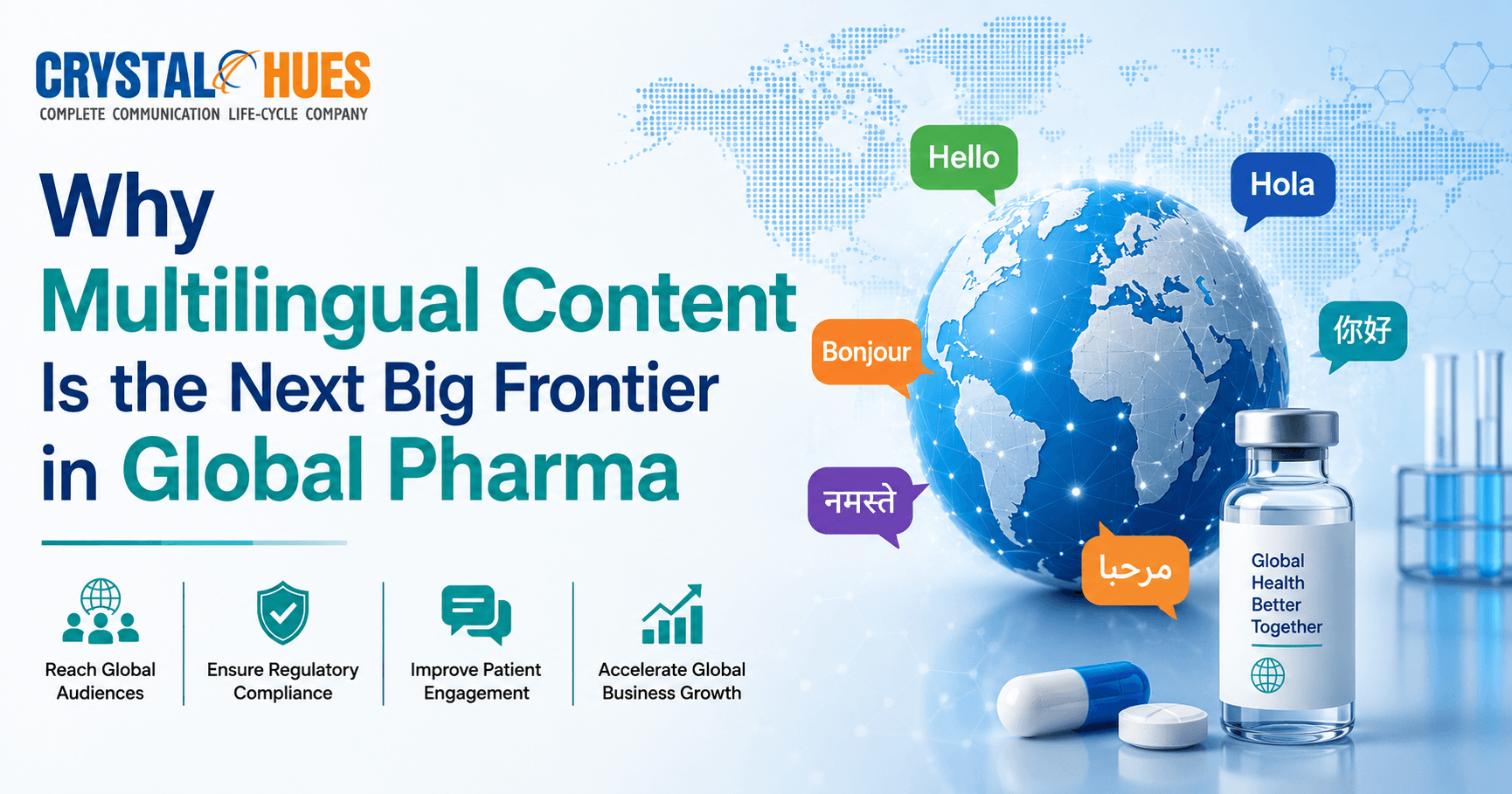
Why Multilingual Content Is the Next Big Frontier in Global Pharma
The pharmaceutical industry is going through one of its most ambitious expansions in history. Clinical trials are running across dozens of countries simultaneously. Regulatory filings are landing on desks in Brussels, Washington, Tokyo, and New Delhi within weeks of each other. Drug launches are happening in markets that speak fortyv different languages before a single patient sees the product.
And yet, somewhere between the breakthrough and the bedside, language still gets treated as an afterthought.
The evolving pharma landscape is bound to be dominated by the companies treating multilingual as a core workflow enhancing smooth expansion around the world.
The Global Pharma Race Has a Language Problem
When a drug moves from approval to market, the content burden is enormous. Patient information leaflets, labelling, informed consent forms, pharmacovigilance reports, clinical study documentation, and promotional material all need to exist in the local language of every market the product enters. In the European Union alone, that means up to 24 official languages. Add Southeast Asia, Latin America, and the Middle East, and the complexity compounds quickly.
Historically, many companies managed this by outsourcing individual documents to local vendors with little consistency or quality oversight resulting in fragmented terminology, regulatory delays, and in some cases, patient safety risks rooted in language error.
The industry is now recognizing that multilingual content as a strategic function that cuts across borders enhancing revenue for global businesses.
Regulatory Bodies Are Raising the Bar
Regulators are getting sharper about language quality. The European Medicines Agency has detailed guidelines on the readability of patient leaflets. The US FDA expects labelling translations to meet precision standards that generic, or machine translation simply cannot guarantee. Health authorities across Asia and Africa are increasingly requiring market authorization submissions in local languages, often with certified accuracy.
This shift means pharmaceutical companies need translation partners who understand both language and the regulatory environment it operates in. A mistranslation in a dosage instruction is a compliance failure. In the worst case, it is a patient safety event.
Getting this right requires deep domain expertise, a structured quality management system, and the ability to operate at global scale without losing local precision. This is exactly where a partner like Crystal Hues brings measurable value. With over 36 years of experience and capabilities across 250 plus languages, we support pharmaceutical clients across the full spectrum of translation and localization services that regulatory submissions and global launches demand.
Multilingual Content as a Patient Access Strategy
The next billion patients for the global pharma industry live in markets where English is a second or third language. India, Indonesia, Brazil, Nigeria, and the Arabic speaking world represent massive and fast-growing populations with rising healthcare access and increasing pharmaceutical consumption. Reaching these patients effectively means communicating with them in their own language, through their own cultural context.
This is where multilingual content becomes a market access strategy.
From digital health platforms to patient support programs, Crystal Hues's localization services are built to help pharmaceutical brands communicate with precision and cultural authenticity across every market they enter. Labels, education materials, digital health apps, and patient support programs all need to reflect the lived reality of the patient receiving them. A generic translation of a patient leaflet into Hindi or Swahili that reads like a translated document will erode trust. Content that reads naturally, with the right register and cultural sensitivity, builds it.
The AI Question in Pharma Translation
Artificial Intelligence is reshaping how translation is produced, and pharma is right in the middle of this shift. Machine translation engines have improved dramatically. For high volume, lower sensitivity content, AI assisted translation can accelerate timelines and reduce costs.
But pharma content sits in a category where the stakes of error are among the highest in any industry. Clinical terminology, drug interaction warnings, and regulatory language require a level of precision that AI alone does not yet deliver consistently. The most effective model combines AI efficiency with expert human oversight, backed by terminology management systems that ensure consistency across every document in every market.
Companies that understand this distinction are building translation workflows that are both fast and reliable, rather than trading one for the other.
What the Future holds for Pharma
The pharmaceutical industry is moving toward decentralized clinical trials, digital therapeutics, and AI driven drug discovery. The companies building their multilingual infrastructure now, with the right partners, the right processes, and the right quality systems, will be significantly better positioned when these shifts accelerate.
We at Crystal Hues Limited have spent over three decades building the expertise, infrastructure, and quality systems to support exactly that mission.
The globalised and fast paced tech- induced innovations in pharma today makes multilingual content an absolute necessity that can define the next decade of pharma services both in access and affordability to the very people that it was meant to serve.