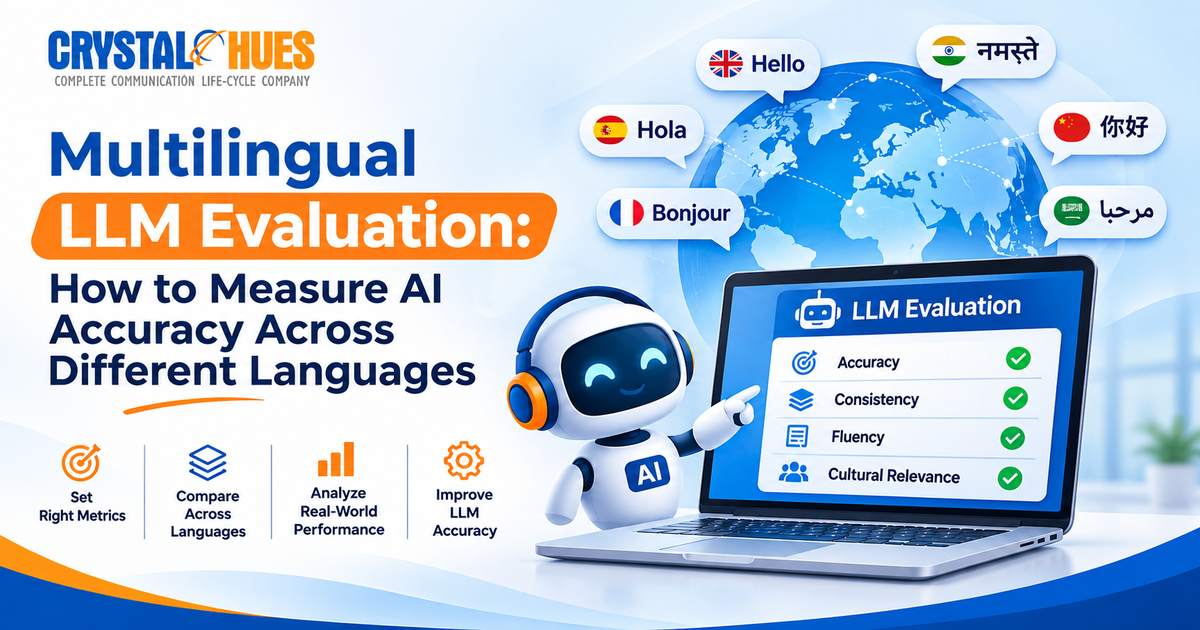
Multilingual LLM Evaluation: How to Measure AI Accuracy Across Different Languages
Introduction
Evaluating a multilingual LLM to
measure AI accuracy is a crucial step to improve model’s efficiency across
different languages. A large language model that answers well in English can
still stumble in Marathi, Arabic or Portuguese. Strong results in one language
do not prove reliable results in others, because training data, vocabulary and
cultural context differ widely. Multilingual LLM evaluation measures task
success, factuality, instruction following, language quality, safety and
cultural appropriateness for each language and use case. This guide explains
what to evaluate, how to build a representative dataset, which metrics to use,
how human review fits in and the mistakes to avoid.
What Is Multilingual LLM Evaluation?
Multilingual LLM evaluation is the systematic testing of model outputs across your
target languages, tasks and user contexts. It tells you where a model is
dependable and where it is not.
It is not the same as translation
evaluation. A model may translate a sentence well and still reason poorly,
retrieve wrong facts or ignore instructions when the prompt arrives in another
language. This is why cross-lingual performance must be tested directly and not
assumed.
The benchmark you choose should also match your application. A public benchmark built for general question answering says little about how a model will summarize insurance documents or support customers in a specific region.
What Should You Evaluate?
Test each area below separately for every
language and locale.
Language quality and comprehension. Check fluency, grammar, meaning preservation and whether the model
understands natural, everyday prompts.
Task performance. Measure instruction following, question answering, summarization,
information extraction or whichever tasks your product depends on.
Factuality and groundedness. Factuality means the answer is correct against trusted references.
Groundedness means it stays faithful to the source material you gave it.
Hallucination testing looks for confident statements that are simply untrue.
Reasoning and consistency. Ask the same question in several equivalent ways. A reliable model
gives coherent answers across paraphrases.
Safety, bias and cultural context. Look for harmful content, stereotypes, poor handling of sensitive
topics and phrasing that is inappropriate for a given locale. A bias assessment
should be run in each language, since problems can appear in one and not
another.
Robustness. Real users make spelling variations, use dialects, mix languages in one sentence (code-switching), type in transliterated form and write long or ambiguous prompts. Include these in testing.
Build a Representative Multilingual Evaluation Dataset
Your evaluation dataset decides how
trustworthy your results are. Choose languages and locales based on your actual
users and business needs, and do not assume every language has the same amount
of data available.
Include native prompts written by real
speakers, task-specific examples, edge cases and realistic domain terminology.
Machine-translated English prompts are quick to produce but often miss how
people really write, so they should not be the only source.
Create reference answers or scoring rubrics
with qualified reviewers, and record where each item came from and how it
changed over time. Keep the evaluation set strictly apart from model training
and prompt-tuning data. If test items leak into training, scores look better
than the model deserves. Building and labelling such sets is specialist work,
and many teams draw on AI
data services and AI
data annotation and labelling to prepare them.
Metrics and Evaluation Methods
Use task-specific automatic metrics where
they fit. Exact match works for extraction, and overlap-based scores can help
with summarization. Their limits show up quickly in open-ended generation,
where many different answers can all be correct.
For that reason, pair automatic scores with
human evaluation of meaning, cultural context, usefulness and finer points of
language quality. Track factual correctness, instruction compliance, task
completion, refusal and safety behavior, and error rates for each language.
Report results per language and per task,
alongside any overall figure. A single average can hide a weak language
completely. Share sample sizes and uncertainty where you can, since a result
from fifty prompts is far less certain than one from five thousand.
No universal metric or benchmark ranks
every model fairly. LLM benchmarking is most useful when it is built around
your use case. Teams that need structured review and feedback loops can look at
AI testing and
feedback support.
Human Evaluation and Quality Governance
Human review is where nuance gets judged.
Use qualified native or domain reviewers and give them clear rubrics with
calibration examples so everyone scores in the same way.
When reviewers disagree, settle it through
adjudication, which means a senior reviewer makes the final call. Keep an error
taxonomy, a simple list of error types such as wrong fact, wrong tone or missed
instruction, so you can see patterns and prioritize fixes. Marking meaning,
entities and intent consistently also helps, and semantic
annotation can support that work.
Document who reviewed what, how samples
were chosen and what the limits of the process are. Prompts may contain
sensitive information, so handle them with care.
Common Evaluation Mistakes
Several errors come up again. Teams test
only translated English prompts, report only aggregate scores or use benchmark
data the model may have already seen, which is called contamination. Others
ignore locale and dialect differences, lean too heavily on automatic metrics or
treat a small sample as proof of broad language capability.
How Crystal Hues Can Support Multilingual AI Data and
Evaluation Work
Crystal Hues offers NLP services, AI testing and feedback, semantic annotation and AI data annotation and labelling as part of its wider AI data services. These can be relevant when you need language data, linguistic review or structured feedback for multilingual model evaluation. Review the service pages to see how they fit your languages and use case and talk to the Crystal Hues team about your requirements.
Conclusion
A model’s output is a direct function of
the dataset it learns from, and in a multilingual setting that dataset must
reflect many languages, dialects and contexts. Recognizing and measuring how a
model performs in each language, and in each context where it will be used,
sharpens its outputs and keeps the results coherent and accurate. A strong
average score is not enough if one language quietly falls behind.
If you are planning multilingual LLM evaluation, explore Crystal Hues’ AI testing and feedback and AI data services, or talk to our team about your requirements.
Frequently Asked Questions
What is multilingual LLM evaluation?
It evaluates model’s performance across
different languages by looking at accuracy cultural fit and translation.
How do you measure LLM performance across languages?
To measure LLM performance, specific test sets
for each language, score task success and human reviews need to be considered.
Are automatic metrics enough to evaluate multilingual AI?
No, human oversight is needed to catch
unforeseen errors for open ended text, tone and cultural context.
Why is human evaluation important for
LLMs?
People can judge meaning, nuance,
appropriateness and usefulness in ways metrics cannot. Qualified native
reviewers also catch errors that look fluent but are wrong.
How often should multilingual LLM
benchmarks be updated?
Multilingual LLM benchmarks should be updated whenever the model, prompts or use case change. Old benchmarks can become contaminated or stop reflecting how users write.