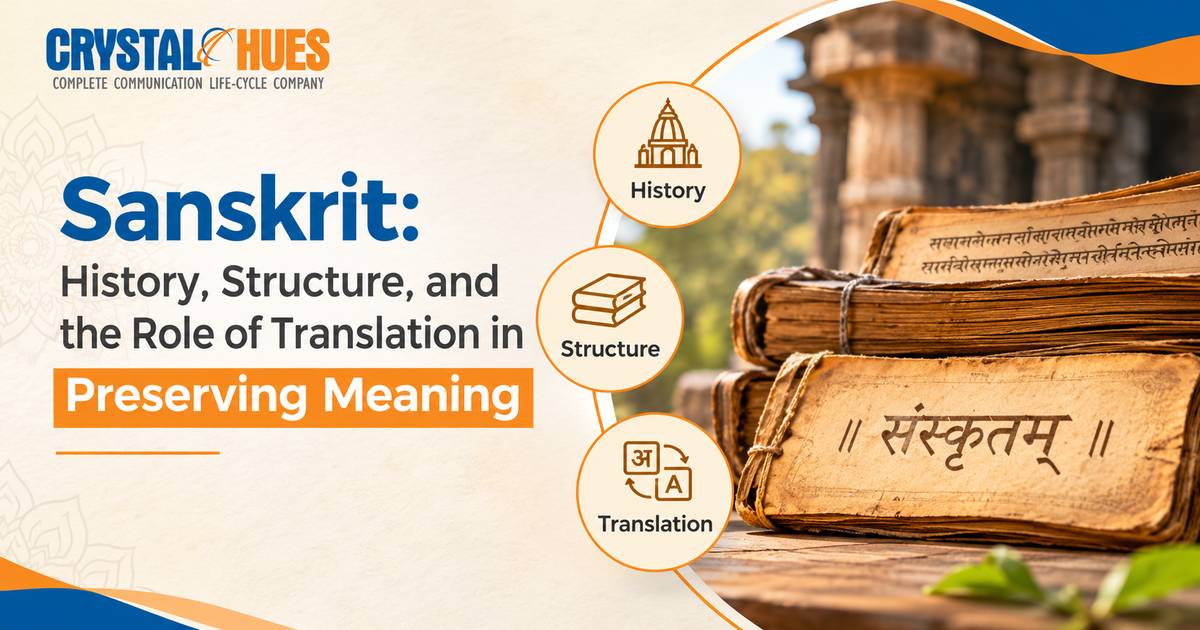
Sanskrit: History, Structure, and the Role of Translation in Preserving Meaning
Introduction
Sanskrit forms the bedrock of our colossal civilisational history which has its roots back to the centuries. Today, most people know it as it as Devanagari. This distinction matters for anyone reading, publishing, or translating Sanskrit, because the script is only the surface. Underneath it sits a language where one word can hold several meanings, and keeping those meanings intact is the real challenge.
What Is the Sanskrit Script?
Sanskrit is a classical Indian language
that has carried religious texts, philosophy, grammar, poetry, and scientific
writing for thousands of years. It never had a single script of its own. When
people say, “Sanskrit script,” they usually mean the script a particular text
is written in. For modern books and teaching materials, that is Devanagari.
Devanagari is shared with other languages, including Hindi, Marathi, and Nepali. It is better to think of it as a container that can hold different languages than as something that belongs only to Sanskrit.
History and Structure of Sanskrit Writing
How the writing developed
Sanskrit was passed on orally for a long
time, with texts memorised and recited by generations of learners. Writing came
later, mostly in scripts descended from Brahmi, which is known from Mauryan-era
inscriptions around the 3rd century BCE.
Brahmi gradually branched into regional
scripts, and Sanskrit manuscripts followed these branches. Scribes in Kashmir
used Sharada, and in the south, Grantha was common. In the north, Nagari forms
emerged, and Devanagari took its settled shape over the medieval period.
How the script works
Devanagari is built around a simple idea.
Each consonant letter already carries a short “a” sound, so क is read as “ka”, not “k”. To change the vowel, you attach a sign: कि is “ki” and को is “ko”. To remove the
vowel entirely, you add a mark called the virama, which turns क into a bare “k”. Linguists call this kind of system an abugida.
Sanskrit words also contain many consonant
clusters. Instead of writing each letter in full, Devanagari merges them into
one form, as in क्ष (kṣa) or त्र (tra). These combined forms are often the hardest part for beginners,
and they appear constantly in Sanskrit manuscripts.
Most letters hang from a horizontal line, and the text runs left to right. The Sanskrit characters are also arranged logically by where they are pronounced in the mouth, which shows how carefully the language’s sounds were studied.
Sanskrit Script and Devanagari: What Is the Difference?
Sanskrit is the language: its words,
grammar, and meaning. Devanagari is the writing system: its letters, signs, and
spacing. You can change one without touching the other.
The same Sanskrit verse can be printed in
Devanagari, copied in Grantha, or written in Roman letters through
transliteration, and it is still the same Sanskrit. In the other direction, a
page written in Devanagari might be Sanskrit, Hindi, or Marathi.
Hindi causes the most confusion because it looks so similar on the page. It is a separate language with its own grammar and vocabulary, and translating it is a different task. You can read about that on our Hindi translation services page. Our languages we translate page also shows how different languages and writing systems are handled.
Why Sanskrit Translation Requires Linguistic and Cultural
Context
Reading the characters is only the first
step. Sanskrit translation also means understanding what the words meant to the
people who wrote them.
Take dharma. Depending on the text,
it can mean duty, law, order, or righteousness. No single English word covers
all of that. A translator who picks one without checking the passage can
quietly change its meaning.
Historical usage matters too. A word in an early Vedic hymn may not be used the same way in a later philosophical work. Technical terms in grammar, medicine, or ritual have precise meanings that only subject knowledge can unlock.
Common Challenges in Translating Sanskrit Texts
- Ambiguous meanings: Many words have
several valid senses, and only the surrounding passage shows which one
applies.
- Compounds: Sanskrit often joins
words into long compounds, and some can be read in more than one way. A
term like rājapuruṣa could mean “the king’s man” or something
closer to “royal official”, depending on context.
- Context-dependent terms: Ideas from
philosophy or ritual may have no direct equivalent in the target language.
- Cultural references: Names, myths,
and traditions often assume background knowledge the modern reader lacks.
- Tone and intent: A verse may be
devotional, instructive, or poetic. Flattening it into plain prose loses
part of the message.
If you are working with Sanskrit content, our Sanskrit translation services page explains the support we offer.
How to Maintain Accuracy When Translating Sanskrit Texts
Good ancient text translation depends on
process as much as skill:
- Check the source first. Confirm the
script and edition and read the original carefully before translating.
- Bring subject knowledge. A
philosophical text and a medical one need different expertise.
- Research the context. See how key
terms were used in that period and tradition.
- Keep terminology consistent. Decide
how recurring terms will be rendered and use them the same way throughout.
- Review the result. A second reader
catches errors the first one misses, which protects linguistic accuracy.
You can read more about our approach on our professional translation services page.
When to Seek Professional Translation Support
A learner can often handle short passages
with a good dictionary. Professional help becomes worthwhile when a text is
long, specialised, or headed for publication, or when mistakes would be costly.
Publishers, researchers, and cultural organisations often fall into this group.
If translated content is moving online or into new markets, language localization services and website translation services can help it reach readers in a form that works for them.
Frequently Asked Questions
What script is Sanskrit written in?
Sanskrit is written in Devanagari script
but historically it also appeared in Brahmi-derived scripts such as Sharada
and Grantha.
Is Sanskrit the same as Devanagari?
No. Sanskrit is a language, and Devanagari is
script used to write it.
Can Sanskrit be written in other
scripts?
Yes. It has been written in many regional Indian scripts, and it can also be
written in Roman letters through transliteration.
Why can Sanskrit texts be difficult to
translate?
Depending on historical nuances of this language, the meanings get varied making it difficult to translate.
Why is cultural context important in translation?
Cultural context invokes the real picture of translation making it free from any presumptions.
Conclusion
Sanskrit is a treasure trove for extracting ancient knowledge through accurate translation. It can unlock the secrets that the modern world needs blending technology with tradition. The language is old and layered, and Devanagari is just one of the scripts that has carried it. Accurate translation depends on understanding both the writing system and the context behind the words. When script, language, and context are all respected, the original meaning has a much better chance of surviving the move into another language.