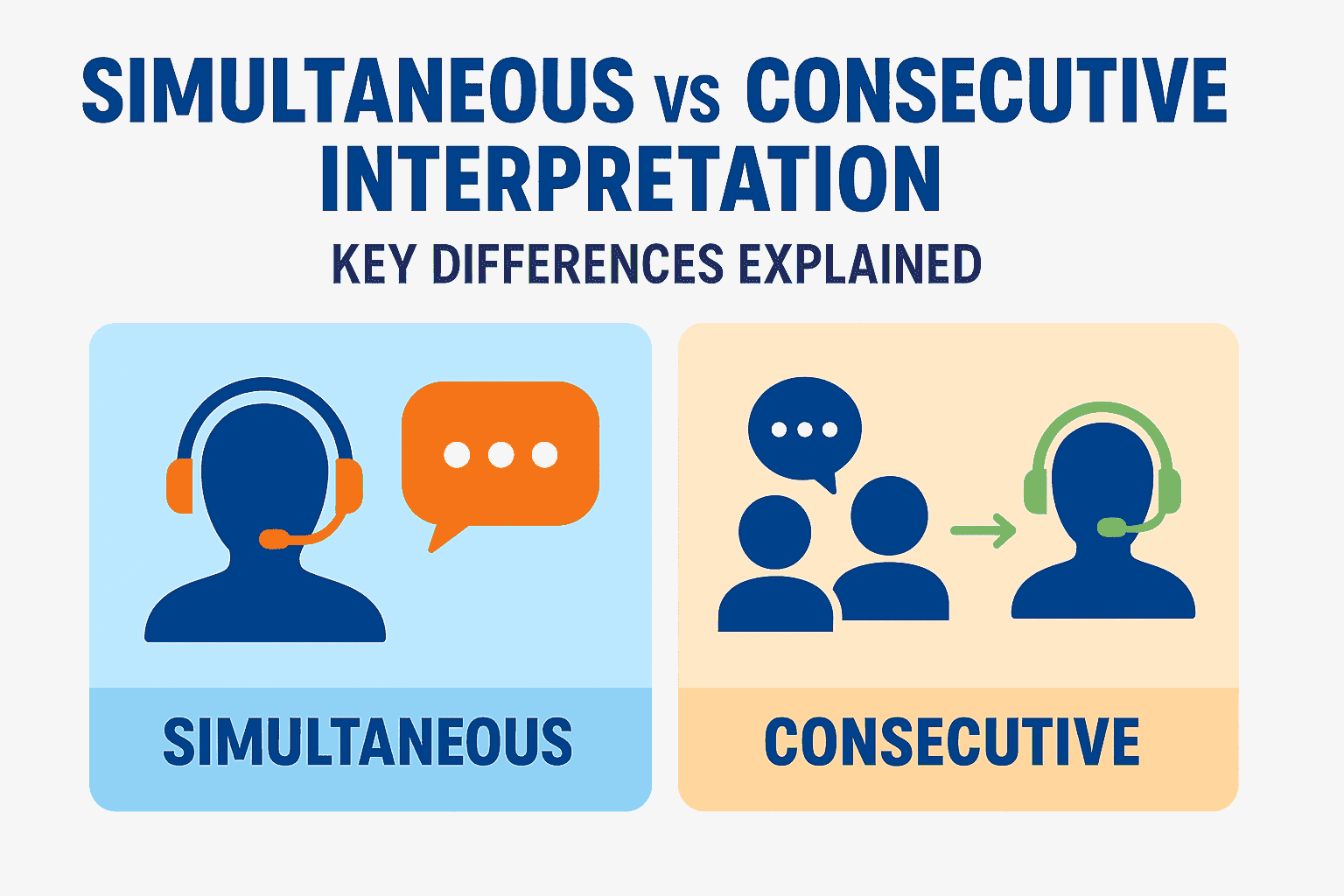
Simultaneous vs. Consecutive Interpretation: Key Differences Explained
A
French CEO is present at a business summit. Her audience is a target of 500
people who knows various languages. Does the interpreter translate as she
speaks, or does she stop after every few sentences? This choice influences the
whole event. A wrong decision irritates both the audiences and speakers.
There
are two major types of interpretation, and each one suits to various
circumstances. One keeps things moving fast. The other values detail and
precision.
Read
the blog to know the difference between simultaneous and consecutive
interpretation. Find out where to use them and turnaround the life.
Simultaneous
Interpretation
Simultaneous
translation occurs instantly. The interpreter will listen to the speaker and
translate in near real time. Typically, there is a span of few seconds between
the words being translated and the original words. The narrator does not cease
his speech. The interpreter will continue working all the time during the
speech or conversation.
This
is a process that involves high concentration. Interpreters must hear, comprehend,
and translate, and speak simultaneously. Their brains deal with several tasks
at once. Interpreters mostly operate in soundproofed rooms with headphones and
microphones. They are provided with the audio feed of the speaker and send
their translation to listeners using wireless receivers.
Characteristics
·
Intensive
equipment: Proper equipment is needed such as
soundproof booth, microphones, headphones and wireless audio transmission
systems.
·
Team-based
method: Two
or more interpreters will work collaborating, changing positions every 20-30
minutes to ensure quality of services and avoid mental burnout.
·
Real-time
speed: The
events are presented in their natural speed without any hiatus, and the
audiences remain active and the programs on track.
·
No
chance to clarify: Interpreters
have no possibility to request speakers to repeat or explain some unclear
points and make immediate decisions.
Applications
Simultaneous
interpretation is very crucial in international business meetings. It is used
in multinational firms conducting board meetings with foreign executives.
This
method is also employed in product launches and developer conferences in the
technology sector. Businesses launch new products to international markets.
Educational
facilities use simultaneous interpretation in overseas seminars and lectures.
Consecutive
Interpretation
The
consecutive interpretation is different. The orator speaks a part, then takes a
break. In this break, what has been said is translated by the interpreter. When
the translation is complete, the speaker continues. It is a trend that is
followed in the conversation or speech.
The
interpreters make notes as the speaker goes. They come up with short-hand
systems of symbols and abbreviations. The notes enable them to recall important
details, figures, names, and flow of ideas. Good note taking is what
distinguishes between great interpreters and mediocre interpreters.
Characteristics
·
Minimal
equipment: Minimal
equipment needs very little or no technical installation, typically it only
needs the interpreter standing close to the speaker.
·
Longer
time: It takes twice as much time
since everything is said in both languages in a row order.
·
Note-taking
requirement: Interpreters
create their own shorthand systems to memorize important points, numbers,
logic, etc. with symbols and abbreviations.
·
Increased
accuracy: Allows a more accurate translation since interpreters can take time
to digest complicated concepts.
·
Possible
clarification: Sometimes,
speakers may be requested by an interpreter to repeat or clarify confusing
statements throughout the pauses.
·
Inbuilt
rest intervals: The
successive nature of listening and speaking give the interpreter mental rests.
Applications
Consecutive
interpretation is based on diplomatic meetings of government officials.
Discussions of treaties or agreements at a high level require greater accuracy
than speed. Authorities are cautious in words and translators are accurate in
meanings. This restraint is appropriate in the formal character of diplomacy.
This
method is effective in small business environments such as factory tours or
training. A technical specialist describes how machinery works to foreign
customers. The interpreter makes sure that all safety details and instructions
are passed across clearly.
Key
Differences
|
Aspect |
Simultaneous Interpretation |
Consecutive Interpretation |
|
Timing |
Happens in real time with
few seconds delay |
Occurs after speaker pauses |
|
Equipment needs |
Requires booths,
headphones, microphones, receivers |
Needs minimal or no
equipment |
|
Number of interpreters |
Usually requires two or
more working in shifts |
One interpreter can handle
the session |
|
Event duration |
Same length as original
presentation |
Takes approximately twice
as long |
|
Accuracy level |
Captures overall message
and main points |
Provides higher precision
and detail |
|
Note-taking |
Not typically used |
Essential for the process |
|
Best for audience size |
Large groups and
conferences |
Small groups and personal
meetings |
|
Mental demand |
Extremely intense and
continuous |
Challenging but with
built-in breaks |
|
Cost |
More expensive due to
equipment and multiple interpreters |
Less expensive with simpler
setup |
|
Interaction style |
Impersonal and technical |
More personal and
interactive |
How
to Choose Between These Two
- Event size: Huge meetings with
hundreds and thousands of members require simultaneous interpretation.
Consecutive interpretation is more suitable in small meetings of less than
20 people.
- Time constraints: Select
simultaneous interpretation where time is limited and you cannot spare
time. Use consecutive interpretation when precision and in-depth
comprehension is more important than speed.
- Budgetary factors: Simultaneous
interpretation is more expensive because it must rent equipment and hire
several interpreters. The consecutive interpretation needs fewer
investments and fewer logistics.
- Complexity of content: Technical, legal or
medical content is highly technical and thus can be interpreted
consecutively as interpreters handle complex words accurately.
Simultaneous interpretation is okay for general business discussions or
presentations.
- Formality level: Consecutive
interpretation is traditionally used in formal diplomatic meetings and
legal processes. Simultaneous interpretation is normally used in corporate
meetings and mass gatherings.
Simultaneous
and consecutive interpretation are vital in our globalized world. There is no
natural superiority between the two approaches. Choose carefully, and your
message would be received by all.