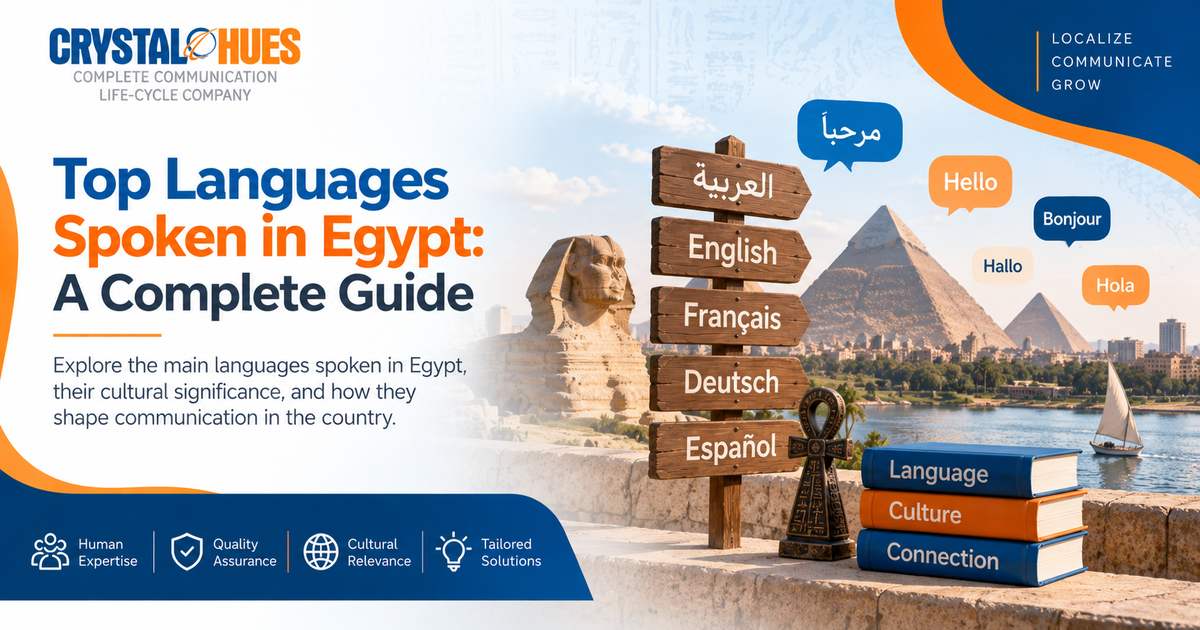
Top Languages Spoken in Egypt
Egypt is home to more than 116 million people. And its language landscape Just as vibrant as its culture. Most people instantly think of Arabic when they think of Egypt. However, there is so much more.
Egyptian Arabic itself is quite different from what you’ll hear in other Arab countries. It has evolved over centuries, shaped by local traditions, outside influences, and everyday life.
A big reason for this linguistic mix is Egypt’s location. The country sits at the meeting point of Africa, Asia, and Europe. Add the Suez Canal, which handles around 12% of global sea trade, plus millions of tourists and thousands of international businesses each year, and you get a place where languages naturally overlap.
For companies entering the Egyptian market, tourists, and anyone collaborating with Egyptian partners or clients, understanding this multilingual environment is a huge advantage. It helps you communicate better, avoid misunderstandings, and build stronger connections.
In this blog, we look at the most widely used languages in Egypt and explain why each one matters in today’s modern, connected Egyptian society.
Egyptian Arabic
Egyptian Arabic is the language you’ll hear everywhere. Be it homes, markets, taxis, cafés, and daily conversations. Around 76 million people speak it as their first language, which makes up roughly 70% of Egypt’s population.
Like any living language, Egyptian Arabic changes from region to region. Accents and dialects vary noticeably. For example, Sa’idi Arabic, also known as upper Egyptian Arabic, sounds very different from the Cairene dialect most foreigners hear. These local variations carry emotional and cultural nuance that Modern Standard Arabic simply can’t express.
Modern Standard Arabic
Modern Standard Arabic (MSA) is Egypt’s official language. You’ll find it in government paperwork, news broadcasts, formal speeches, and school textbooks.
But here’s the interesting part: people don’t speak MSA at home. Children learn it in school, much like learning a formal version of their own language. It’s mainly used in writing, classrooms, and religious discourse, especially by scholars.
This creates a natural divide. Educated Egyptians often move comfortably between Egyptian Arabic and MSA. Less-educated communities may struggle with the more formal register, which can create challenges in areas like law, healthcare, and public services.
English
English is the most widely used foreign language in Egypt. About 35% of Egyptians speak some level of English. And the tourism sector runs heavily on it. Before recent global disruptions, Egypt welcomed around 13 million tourists each year, many from English-speaking countries or places where English is the shared language.
And in major cities, business districts, and tourist hubs, English is an essential tool for communication.
French
French remains present in Egypt. However, its influence has declined over time. Around 1.2% of Egyptians speak French, a legacy of the strong cultural influence France had during the 19th and early 20th centuries. You’ll still find French used in some schools, cultural institutions, and older generations.
Other Languages in Egypt
There are several minority languages existing in Egypt. Coptic Christians use liturgical Coptic in services. It is never spoken in conversation. However, it is still used in church services.
Siwi is a Berber language that is exclusive to this remote group of approximately 20,000 people. They have their own cultural practices and language.
Bedouin cultures speak Bediki dialects. These are quite different to Egyptian Arabic.
The Importance of a Professional Translation Agency for Working with Egyptian Languages
Operating a business in Egypt without reliable translation support is like driving with a blindfold on. You might get moving. But you’re bound to hit a wall soon.
Take something as simple and essential as registering a foreign company in Egypt. Every official document must have an accurate Arabic version. Birth certificates, company registration papers, contracts, authorization letters. If any detail is mistranslated or overlooked, the government will reject the application instantly.
This isn’t just a matter of language; it’s a matter of compliance and precision. A professional translation agency ensures that every document meets legal standards, reflects the correct terminology, and avoids costly delays or denials.
Marketing gets tricky too. One American firm, for example, attempted to market their items in Egypt by direct English to Arabic translation. But the campaign flopped. Why? Because, what sounds good in the American English may sound weird to the Egyptian ears.
Good translation agencies understand this. They rebrand marketing messages to accommodate the local culture retaining the original meaning.
Medical translation has the greatest stakes. The patient may not even be aware of what they are consenting to in case the translator omits some of the important medical terms. This brings about legal challenges and endangers lives. Medical translators are specifically trained to handle such scenarios.
These are just some instances which explain the importance of professional translation services.
Conclusion
The language of Egypt indicates the presence of the crossroads of civilizations. The spirit of everyday life is in Egyptian Arabic. Modern Standard Arabic is dignified and regionally affiliated. English is the gateway to the world economy. French is still lingering as an indicator of refinement. Minority languages have ancient customs.
Such diversity enhances the Egyptian culture. Modern Standard Arabic allows the country to interact with the Arab world. It can conduct international business in English.
However, diversity also comes with practical problems. Businesses are forced to work through various linguistic registers. Government services should be provided to citizens with different language skills. The global business relations require attentive translation. Tourism demands the perpetual switching of language.
These gaps are filled in by the translation agencies in a professional manner. They facilitate the entry of international companies into Egyptian markets. Further, they help Egyptian companies grow internationally and guarantee compliance with the law and sensitivity to culture.
You have reached the end. Thank you for reading our blog. We hope you found it informative and useful. For more such content on to help you stay informed on our language services, you can check out our blog page here.
If you have any feedback or suggestions on what you’d like for us to cover or how we can make our blogs more useful, you can reach us through our LinkedIn inbox or email us at digital@crystalhues.in.