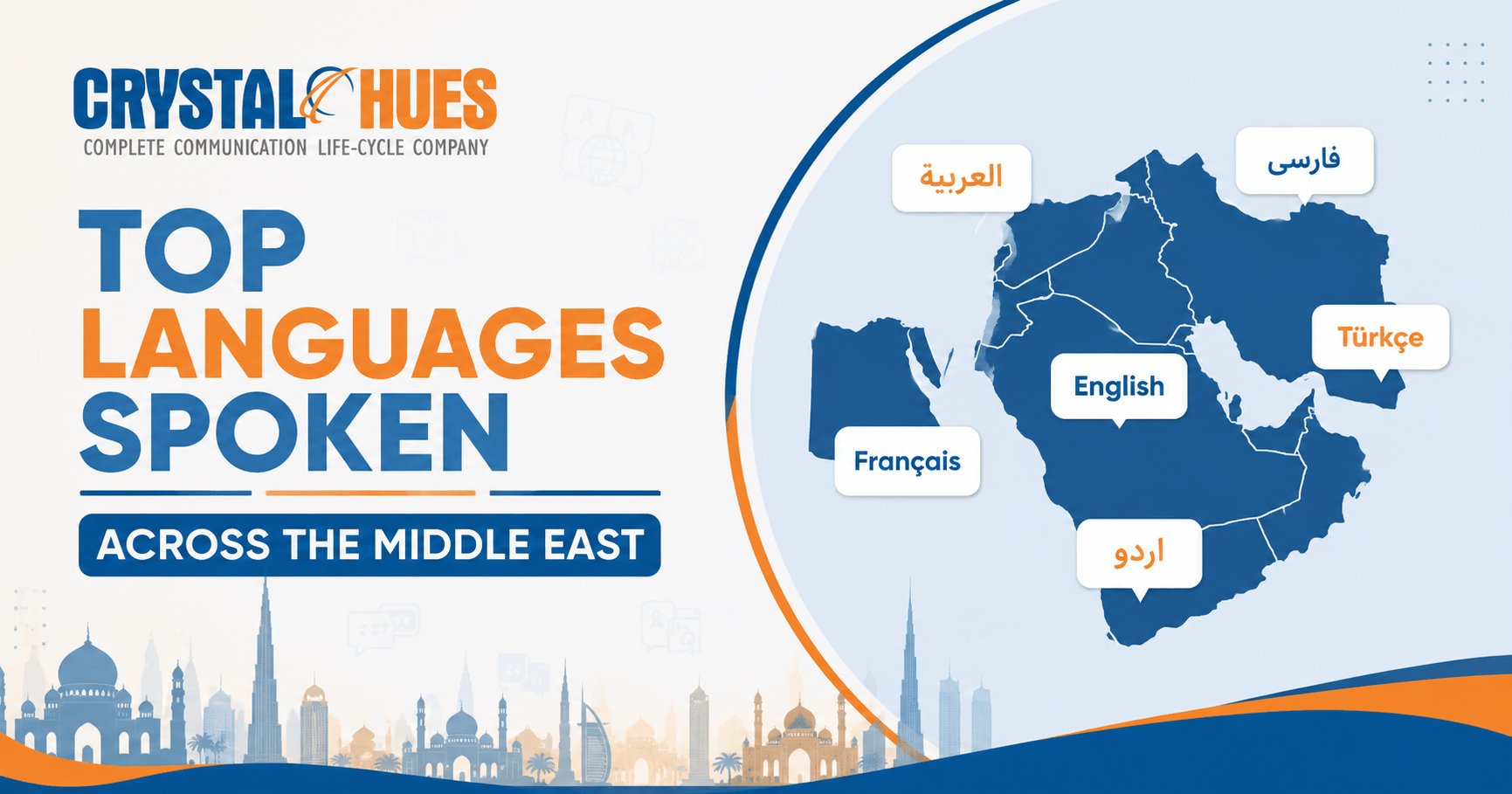
Top Languages Spoken Across the Middle East
What languages are spoken in
Middle East?
Arabic is
the dominant language across the Middle East, spoken as an official
language in seventeen countries in the region, though the spoken dialects
differ enough between countries that a single Arabic translation rarely works
everywhere. Persian dominates in Iran, Hebrew in Israel, Turkish in Turkey, and
English and Hindi function as widely used business languages across the Gulf
states, given the large expatriate workforce there.
For any business expanding into the Middle East, language strategy starts with understanding that this region is far less linguistically uniform than it appears from the outside
How do dialects influence
languages?
Modern Standard Arabic is the formal,
written form used across media, official documents, and education throughout
the Arab world, and it works well for formal business communication, contracts,
and government facing content.
Spoken Arabic, however, splits into distinct regional dialects. Gulf Arabic, spoken across Saudi Arabia, the UAE, Qatar, Bahrain, Kuwait, and Oman, differs noticeably from Levantine Arabic, spoken in Jordan, Lebanon, Syria, and Palestine, which in turn differs from Egyptian Arabic, the most widely understood dialect across the region thanks to Egypt's dominant media industry. A marketing campaign written in Egyptian Arabic can feel foreign to a Gulf audience, and the reverse holds true as well.
For a business, this means one Arabic translation genuinely does serve every market, and choosing the right dialect for the right country is a real localization decision, not a minor detail.
What are the main spoken
languages of Gulf?
The UAE, Saudi Arabia, Qatar, and Kuwait
all run a significant share of their business and commercial life in English
alongside Arabic, largely due to the size of their expatriate populations and
their positioning as international trade and finance hubs. Dubai and Abu Dhabi operate
almost bilingually in commercial settings.
That does create a shortcut for businesses. English language content works for initial market entry and B2B outreach across the Gulf, but Arabic remains essential for consumer facing content, government contracts, and building genuine local trust. A business that skips Arabic entirely in the Gulf misses the audience that decides whether a brand feels local or foreign.
What languages are spoken in Iran, Israel, and Turkey?
Persian,
known locally as Farsi, is the primary language of Iran, and it uses its own
script, a modified form of the Arabic alphabet, which means Persian content
needs dedicated linguists rather than an Arabic translation adapted at the
edges.
Hebrew is
Israel's official language, written right to left like Arabic, but
linguistically unrelated to it. Israel also runs a large English-speaking
business and tech sector, which gives businesses more flexibility for initial
outreach than in most of the region.
Turkish, spoken across Turkey, uses the Latin alphabet, which makes it visually more familiar to Western businesses, though the grammar and sentence structure differ substantially from English, and machine translation alone tends to produce noticeably awkward results here.
What This Means for a Business Entering the Middle East
A single Middle East localization strategy
rarely works well in practice. The region genuinely functions as several
distinct language markets sitting next to each other and treating it as one
requires either a broad Modern Standard Arabic approach for formal content or a
country specific dialect and language strategy for anything consumer facing.
The businesses that succeed here typically start with English and Modern Standard Arabic for initial market entry, particularly in the Gulf, then invest in dialect specific Arabic, Persian, Hebrew, or Turkish content as they commit to a specific country. Getting this sequence right saves both budget and credibility, since launching with the wrong dialect in a consumer market reads as a real misstep to a local audience, not a minor language nuance.
How Crystal Hues Supports Middle East Expansion
Crystal Hues works across Arabic, Persian, Hebrew, and Turkish, with linguists who work in
the specific dialect a market needs rather than one generic Arabic translation
applied everywhere. That matters most for businesses entering the Gulf, where a
Saudi Arabia launch and a UAE launch can call for genuinely different dialect
choices even though both fall under the same broad Arabic language.
For a business still deciding where to
start, translation services cover the formal, Modern Standard Arabic layer most
companies need first, contracts, government documents, and B2B communication.
As a brand moves toward consumer facing content, localization services handle
the dialect specific adaptation that makes a website or campaign feel native to
a Gulf, Levantine, or Egyptian audience rather than translated at it.
With coverage across 250 plus languages, Crystal Hues can support a phased Middle East strategy from day one, starting with English and Modern Standard Arabic, then adding country specific dialects and languages as a business commits to individual markets.
FAQs
What is the main language of the Middle
East?
Arabic is the dominant language, official in seventeen countries across the region, though spoken dialects differ significantly by country, alongside Persian in Iran, Hebrew in Israel, and Turkish in Turkey.
Is English enough to do business in the
Middle East?
English works well for initial outreach in the Gulf states given the large expatriate population, but consumer facing content, government contracts, and building local trust generally require Arabic or the relevant national language.
Do all Arabic speaking countries in the
Middle East use the same dialect?
No, spoken Arabic splits into distinct regional dialects, Gulf, Levantine, and Egyptian among them, and content written for one dialect can feel foreign to an audience in another, even though Modern Standard Arabic works across all of them for formal content.
Conclusion
The Middle East holds real opportunity for
businesses expanding globally, but the region rewards a language strategy built
country by country rather than one broad approach. Arabic dialect, English
usage, and the presence of distinct national languages like Persian, Hebrew,
and Turkish all shift the right approach from one market to the next.
Crystal Hues works across every language this region speaks and helps businesses sequence
their entry rather than guessing at a one size approach.
If
your business is expanding into the region, talk to Crystal Hues about a language strategy
built around each market you're entering.