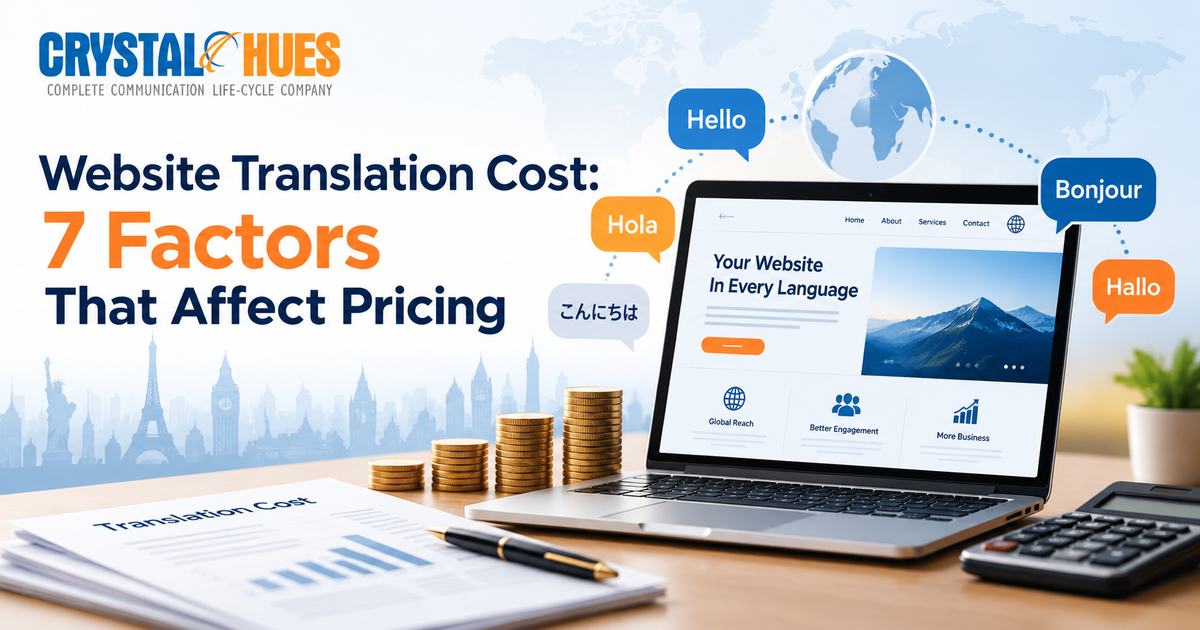
Website Translation Cost: 7 Factors That Affect Pricing
Introduction
Cost
is an important factor for businesses involved in translation. Website Translation
depends on how many words your site has, which languages you need, how
specialised the content is, the quality level you want and the technical work
involved. There is no single price, because no two websites are alike. A fair
quote only comes after someone reviews your pages and understands your goals.
This guide explains how the cost to translate a website is built up, so you can plan a realistic budget before you speak to a vendor. If you are still exploring options, our website translation services page shows how we usually approach these projects.
How Much Does Website Translation Cost?
Website Translation cost depends on your
project. Most providers, including us, price by source word, so the translation
cost per word multiplied by your total word count forms the base of a quote.
Language pair, content complexity and extra services then adjust that figure.
This is why website translation pricing is project specific. A small brochure site and a large online store need very different effort, even if both are going into the same language. We have not listed fixed numbers here because website translation rates change with scope, and a reliable figure needs a content review first.
7 Factors That Affect Website Translation Pricing
Here is what usually shapes a quote, and
why each point matters.
1. Website word count
Your source word count is the total number
of translatable words. This includes page text, menus, buttons, form labels,
metadata and image alt text. A page inventory helps you see what really needs
translating, since not every page has to go live in every language.
2. Language pair
The language pair, meaning your source and
target languages, affects availability of qualified linguists and the effort
involved. Some languages also expand or shrink text, or need right to left
layouts, which adds design and testing work.
3. Content complexity
General business content is simpler than
technical, medical, legal or financial material. Content complexity means we
need subject specialists, glossaries and more careful review, and that is
reflected in the scope.
4. Translation quality level
There are three common routes: translation
only, translation editing and proofreading (TEP), and machine translation
post-editing (MTPE), where a linguist corrects and improves machine
output. The right one depends on how visible and sensitive the content is. Our professional
translation services generally follow a human review process for this
reason.
- Translation only: One linguist
translates the content. It suits low risk, internal or simple content.
- TEP: Translation plus a second
linguist's edit and proofread. It suits public pages, brand content and
product content.
- MTPE: Machine output reviewed and
corrected by a linguist. It suits large volumes of low-risk content.
Pricing differences between these options
depend on your content and need a quote to confirm.
5. Website type and content
An e-commerce store with a big catalogue
has many repeated phrases. A SaaS site has interface text and helps content.
Landing pages need persuasive writing, while technical documentation needs
accuracy above all. Each type of website content translation needs a slightly
different approach.
6. SEO and localization requirements
If you want pages to rank in other
countries, the scope grows. Multilingual SEO can include local keyword
research, adapted page titles and descriptions, and regional formatting, along
with cultural checks on references and examples.
7. Timeline and ongoing updates
Rush deadlines usually need more linguists
working in parallel. If your site changes often, such as new products or weekly
blog posts, you will also need a plan for ongoing updates, not just a onetime
project.
Website Translation vs. Website Localization: Is There a
Cost Difference?
Usually, yes, because localization covers
more work. Translation converts text from one language to another. Multilingual
website localization goes further and adapts currency, dates, units, images,
tone and user experience to suit a region.
That is why website localization cost is
often higher than translation alone: more skills and more checks are involved.
If your goal is to sell in a new market, not just to inform, our localization
services can sit alongside a core translation project.
How to Estimate Your Website Translation
Budget
You can prepare most of what a vendor needs
yourself. Gather these items first:
- Your website URL and a list of pages to translate
- An estimate of your source word count
- The target languages you need
- Content types and any specialist subjects, such as legal or
medical
- SEO, localization and CMS integration needs
- Whether you need editing, proofreading or ongoing updates
Then ask for an itemised quote. It shows exactly what you are paying for and makes it easier to compare options fairly.
How to Manage Website Translation Costs Without
Compromising Quality
Standard quality is must in website translation.
Costs can be managed sensibly, though we cannot promise a fixed saving, and
cutting corners on quality usually costs more later.
- Use translation memory. They help
in storing approved translations to avoid repetition in sentence which
helps with consistency and efficiency.
- Phased Translation. You should adopt agile methodology with developing
priority pages such as your homepage, key product pages and contact
details, then add more over time.
- Prepare your source content. Clear,
final, consistent text is easier to translate and needs fewer revisions.
- Include quality checks and multilingual SEO where needed. Ignoring them can leave pages that read poorly or never get
found.
Frequently Asked Questions
How much does it cost to translate a
website?
The quote depends on your word count,
languages, content type and quality level.
How is website translation priced?
Most projects are priced per source word,
with adjustments for complexity, extra services and timeline.
What factors affect website translation
rates?
Factors affecting rates are word count,
language pair, content complexity, quality level, website type, SEO and
localization needs, and deadlines.
Is website localization more expensive
than translation?
Yes, as it comprises of cultural and
regional adaptation on top of language work.
Does
website translation include SEO?
Multilingual
SEO is an added feature, so ask for it to be listed in your quote.
How long does website translation take?
It depends on volume, number of languages,
review stages and whether the project is rushed.
How can I get a website translation
quote?
To get a website translation quote, share your URL, target languages and requirements with a provider, and ask for an itemised estimate.
Conclusion
With the advent of digital technologies, the
world is becoming connected and so does the need for global market access. Website translation cost is shaped by project
scope, not one universal fixed price. When you understand the factors behind
it, you can plan better and ask sharper questions.
Planning a multilingual website? Visit our
Website Translation Services page, or request
a translation quote for a project specific estimate.