What Are NLP Services? Importance and Benefits
NLP - A must one for AI teams
Modern businesses are vying for quality accurate data to train the LLMs and dominate the AI boom. NLP forms the core backend for their strategy. Before we dive in how, let’s understand what NLP is.
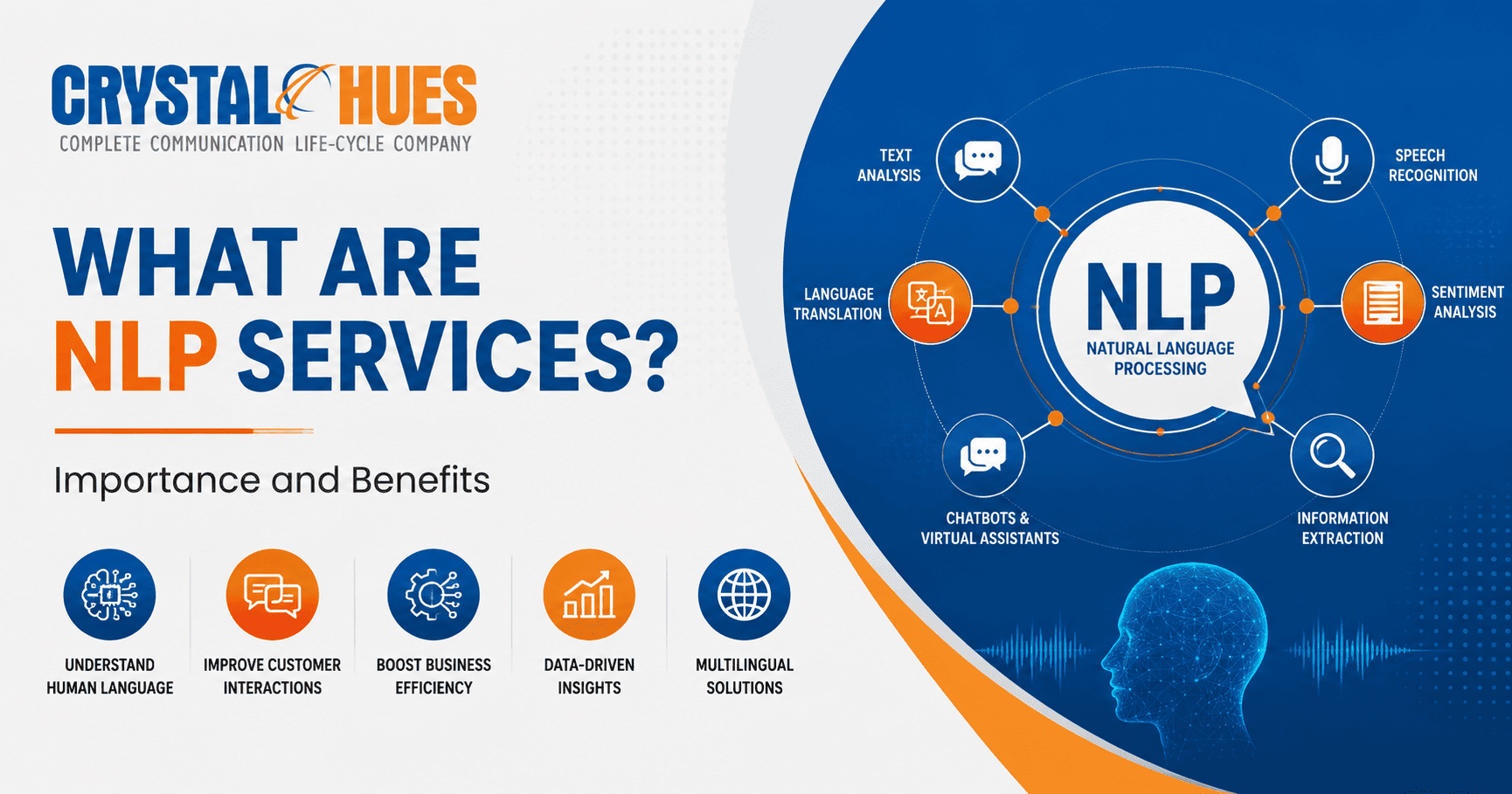
Natural Language Processing (NLP) is the branch of artificial intelligence that teaches machines to read, understand, and generate human language, covering tasks like text classification, entity recognition, sentiment analysis, and translation.
In simple terms, an AI model cannot understand language on its own. It learns language from carefully prepared examples, and NLP services cover everything from building the model itself to preparing the data that trains it.
What NLP Actually Includes
It includes a myriad of entities each contributing to the model’s output. Some of them are listed below.
Text data collection: Every model needs real, diverse language examples to learn from, articles, conversations, product descriptions, and domain specific documents, gathered with attention to context and variety rather than just volume.
Grammar and syntax structuring: Models need engines that understand how sentences are built, so they can parse meaning, generate coherent text, and translate accurately across languages.
Entity and intent tagging: Names, places, dates, and the underlying intent behind a sentence all need clear labels, so a model learns to recognize them consistently rather than guessing.
Multilingual coverage: A model trained only in English carries English assumptions into every other language it touches. Proper NLP data support extends grammar, intent, and entity structuring across every target language a model needs to serve.
Why Skipping This Step Causes Real Problems
A model trained on unstructured or poorly labelled language data tends to misread intent, mishandle context, and perform inconsistently once it meets real users. These failures rarely show up during a demo. They show up in production, once a customer support bot misreads a frustrated customer as a neutral one, or a search feature fails to connect a query to the right result because the underlying entity structure lacked proper design from the start.
Who Actually Needs NLP
Any team building a chatbot, virtual assistant, search feature, translation tool, or content moderation system needs NLP data support at the foundation. It matters most for teams working across multiple languages, since language structure, idiom, and intent shift meaningfully from one language to the next, and a model built only for English will underperform the moment it meets a different linguistic pattern.
How Crystal Hues Delivers NLP
Crystal Hues works across the full NLP delivery stack rather than handling just one piece of it, which matters because most NLP projects genuinely need more than one part.
On the model side, the team builds and fine tunes NLP systems for the specific business problem, contract clause extraction, multilingual ticket classification, clinical note parsing, rather than applying a general-purpose model to a specialised problem and calling it finished.
On the solution side, engagements run end to end. A client brings the use case, and Crystal Hues handles the technical build, the data pipeline, the model training, and the output, so the team receives a working solution rather than a toolkit to figure out alone.
On the data side, annotation teams tag entities, label intents, mark sentiment, and run quality checks across multiple languages, so the data feeding the model stays clean and consistent from the start.
Because all three run under one engagement, there is no hand off between separate vendors as a project moves from data preparation into model training into deployment. Language coverage is the other real differentiator worth naming directly. English dominates most NLP tooling, and languages beyond it, particularly Indian and other Asian language pairs, are often underserved or unusable out of the box. Crystal Hues works extensively across these language pairs as a practical, ongoing area of delivery.
FAQs
What is NLP in simple terms?
NLP is the branch of AI that teaches machines to read, understand, and generate human language, covering tasks like classification, entity tagging, sentiment analysis, and translation.
Why does an AI model need strong NLP work?
Models learn language from examples. Poorly structured or unlabelled examples lead to inconsistent, inaccurate performance once the model meets real users and real language variation.
Does NLP matter for a model built for one language only?
Yes. Even single language models depend on properly structured entity and intent data. The need grows significantly once a model serves more than one language.
Conclusion
NLP data is the groundwork that decides whether an AI model understands language or simply guesses at it. Crystal Hues builds this groundwork for AI teams across more than one hundred languages and dialects, combining three decades of linguistic expertise with a structured, iterative, co-development process.
If your model needs language data built for accuracy from day one, talk to Crystal Hues about NLP services or AI data annotation and labelling built around your specific use case.