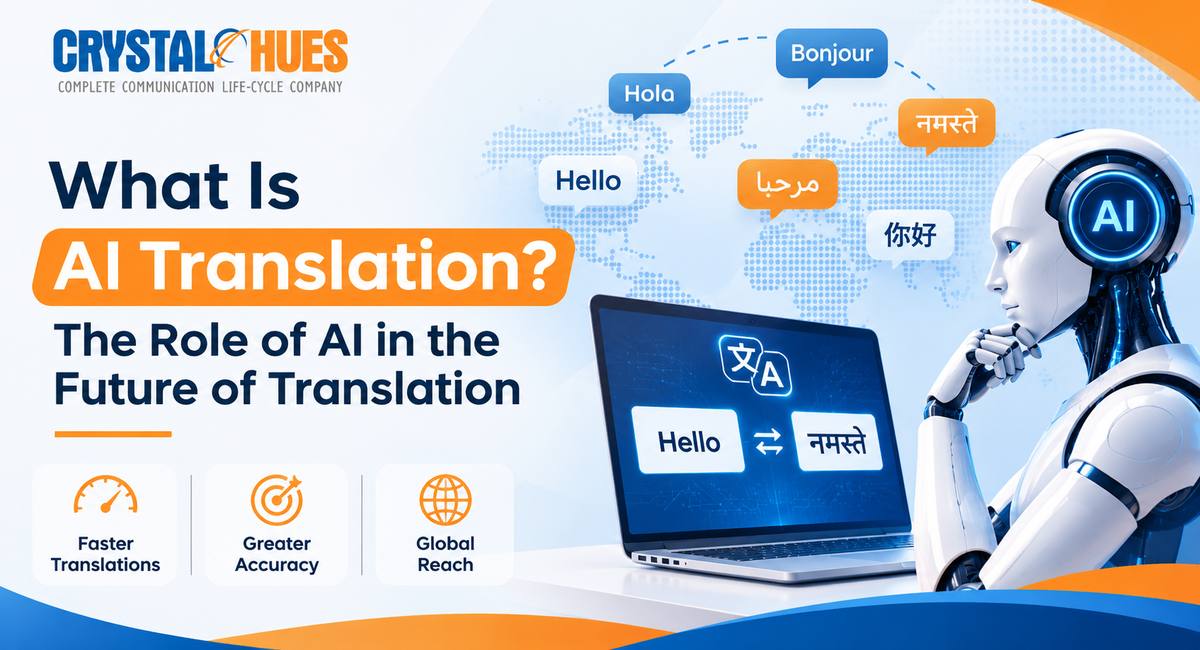
What Is AI Translation? The Role of AI in the Future of Translation
Introduction
We live in a globalised world where
businesses compete for international expansion leveraging artificial
intelligence for its workflow. More businesses now publish, support and sell in
several languages, and AI is changing how that work gets done.
So, what is AI translation? In plain terms, it is software that uses artificial intelligence to turn text from one language into another, often in seconds. This guide explains how it works, what it does well, where it can fail and why skilled human linguists still matter, so you can decide when each approach fits.
What Is AI Translation?
AI translation is the use of computational
models to analyse text in one language and generate a version in another. It is
a form of machine translation, the broader category of software that translates
language automatically. Modern systems often use neural networks, and some use
large language models, to produce output that reads naturally.
Different tools use different designs, so no single description fits every system. Context matters because words change meaning with the sentence around them, and that is why good output takes more than swapping words one for one. AI translation also differs from localization, which adapts content such as formats, examples and tone for a specific market. Our localization services cover that step.
How Does AI Translation Work?
AI translation follows a structured process to maintain uniformity across businesses. Each workflow differs by tool and model, but the standard processes remain same. Firstly, the source text is assembled and fed into the system. The model then analyses the text, language patterns and the necessary context. Using the neural networks for processing, the model generates a final version of the target. Many systems use neural machine translation (NMT), in which a neural network learns patterns from large collections of text. After generating the final version, a subject expert linguist checks it against the desired results. Post editing human review is important to weed out any errors or hallucinations. A model finds patterns in language, and it never understands text the way a person does. That is why review matters for content that carries risk.
Types of AI Translation Technology
- Rule based machine translation:
older systems that follow handwritten grammar rules and dictionaries. It
is mostly useful as background today.
- Statistical machine translation:
systems that learn from large collections of existing translations and
choose likely word sequences.
- Neural machine translation: systems
that use neural networks to translate whole sentences in context and are
widely used today.
- LLM assisted translation: workflows
that use large language models (LLMs), trained on vast amounts of text, to
draft, adapt or check translations. For the hurdles in training these
models across languages, see our post on multilingual
LLM training challenges.
Providers often combine methods, and no single approach is best for every job. Our machine translation page explains how these approaches fit together.
Benefits of AI Translation for Businesses
The benefits of AI translation are quite
palpable in terms of speed and scale. It can deliver drafts quickly, handle
large volumes and support more languages than a small team could cover. When
teams add glossaries and terminology controls, it can also help keep key terms
consistent. These strengths suit content such as product information, support
articles and internal documentation, where speed and scale matter.
The benefits depend on the language pair, the content type, the quality of the tool, the review process and how the workflow is set up. Some content gains a lot, and some gains little.
AI Translation vs. Human Translation
We have seen the benefits of AI translation
above and now we arrive at a classic debate around human vs AI translation and how
it fares across workflows.
Nothing can replace human creativity and
the context it comes with. A wise decision would be to leverage the speed of AI
under human oversight.
Translating is an effective way of
communication. When we compare AI with human, the subject matter expertise of a
linguist matters as they bring domain knowledge while AI can translate at
surface level. Models and LLM’s can hallucinate so a post editing reviewer is
critical as a small error in documents can make or mar a company’s reputation.
Models are as good as the quality of data they are fed up with so the
consistency through human reviews can check for that. To be efficient, pairing an
AI translation with quality gates and a human reviewer can help.
The right choice depends on risk, audience and purpose. A hybrid workflow uses AI for a first draft and qualified linguists for review, known as machine translation post editing (MTPE). ISO 18587 is the international standard for human post editing of machine translation output.
Limitations of AI Translation: Why Human Expertise Matters
AI can struggle with ambiguous wording,
idioms, tone and cultural references. Specialist terminology in legal, medical
or financial content adds risk, and language pairs with limited training data
often perform worse than common ones. The most worrying errors sound fluent
while changing the meaning, so they are easy to miss.
Risk varies by use case. A casual chat message carries little, while a contract or patient instruction carries a lot. Human review, terminology management and quality assurance reduce that risk, although no process removes every error. For a wider look at why AI systems need people, read why AI models need human expertise.
Future of AI in Translation
The future of translation is hard to predict, so treat the following as possibilities. Systems could become more context aware, drawing on surrounding text and subject matter. Speech and multimodal workflows, which combine text, audio and images, may grow. Terminology and context controls could improve, and translation may connect more closely with content operations. Collaboration between people and AI is likely to continue, with linguists reviewing, guiding and training systems. Some of this is already happening, and the rest remains to be seen. AI is still evolving and the long-term cost benefit analysis remains a concern which tech leaders are apprehensive of. So, it’s better to use them cautiously with humans accountable at important steps.
How Crystal Hues Supports Multilingual Communication
Crystal Hues offers translation, localization, MTPE and NLP services, and its site lists ISO 18587 and ISO 17100 certifications. If you have a multilingual project, explore our professional translation services or request a translation quote.
Frequently Asked Questions
What is the difference between AI
translation and machine translation?
AI translation is a subset of machine
translation. AI translation usually refers to modern systems that use
neural networks or language models.
Is AI translation accurate?
No. AI can hallucinate as it depends on the
type of content. Accuracy can be high for simple content and weaker for
specialist or nuanced text.
How much does the AI translation cost?
The cost depends on the requirements. Share
your requirements and you will get a quote.
Can AI replace human translators?
AI handles some tasks well, yet human linguists remain important for review,
cultural judgment and sensitive content.
When should businesses use human review?
Businesses should always use human
review as it fool proofs the translation and builds long term trust.