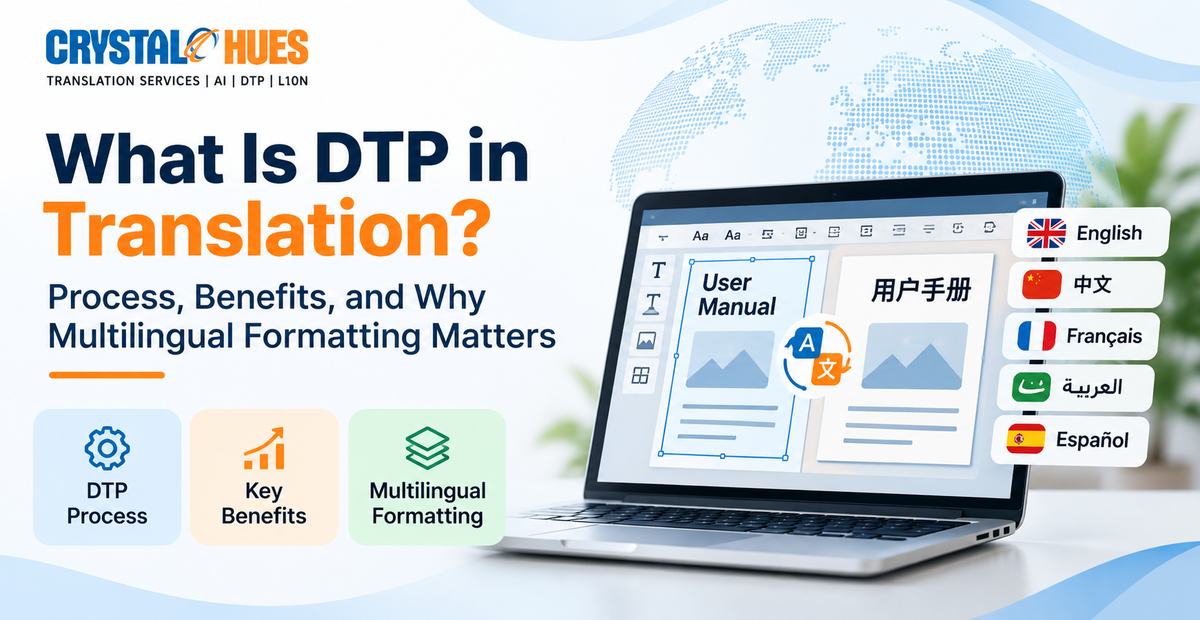
What Is DTP in Translation? Process, Benefits, and Why Multilingual Formatting Matters
Introduction
Imagine receiving a translated brochure and finding headings that spill off the page, a table that no longer fits and a few characters replaced by empty boxes. The words may be correct, yet the document looks broken. That gap is what DTP in translation fills. Desktop publishing (DTP) adapts the layout of translated content, so it looks right and reads easily in the new language. This article covers what DTP in translation is, how the process works, the formatting challenges to expect and why it matters for multilingual projects.
What Is DTP in Translation?
DTP in translation is the desktop
publishing and layout work done on translated content, so the final document is
visually correct, readable and usable in the target language. It covers
typesetting, layout adjustment, font handling, image and text placement and the
preparation of final files.
Translation renders the words in the new language. DTP formats and adapts the designed document around those words. It is a separate step from translation and from linguistic proofreading, although the three depend on each other. You may also see it called DTP translation or desktop publishing translation, and the term multilingual DTP is used when several languages are involved. The work can include multilingual typesetting, layout adaptation and file preparation for print or digital use.
Why Is DTP Important in Multilingual Translation?
Translated text rarely fits the old design
exactly. Length changes from language to language. An English sentence
translated into German may need noticeably more space, while the same idea in
another language may need less. Scripts differ too, and a font that works for
English may lack characters that another language needs.
Without adjustment, you can end up with
clipped text, awkward line breaks, uneven spacing, misaligned graphics or pages
that are hard to read. Consider a left to right brochure adapted for a right to
left (RTL) language. It needs more than swapped text, because the reading order
of the page, the alignment of images and the position of page numbers may all
change. These are illustrations, and results vary by language pair and content.
How Does the Multilingual DTP Process Work?
The multilingual DTP process starts with
receiving the source files, linked images and fonts. Then we confirm target
languages and design requirements. Then, the approved translated text is put
into layout.
At last, the formatted files are reviewed and delivered in the agreed formats, editable, print ready or both.
Common Challenges in Multilingual DTP
The process involves challenges as it has
complex workflows.
- Text expansion or contraction:
translated text may need room, so boxes, buttons and tables need resizing.
- Font compatibility: some fonts lack
characters for certain scripts, which can show empty boxes or mismatched
styles.
- Line breaks and hyphenation: rules
differ by language, and long words or languages written without spaces
between words break differently.
- RTL and mixed direction text:
numbers, product names and Latin words inside RTL text follow their own
direction, which can scramble lines if handled carelessly.
- Localized graphics: text inside
images and screenshots needs editable artwork or careful artwork
adaptation.
- Tables and charts: column widths,
labels and number formats may change.
- Page count changes: tables of contents, indexes and cross references must be updated.
Benefits of Professional DTP in Translation
Professional DTP keeps your brand looking
consistent across languages, produces readable documents, reduces layout
defects and makes content easier to use. It also gives you production ready
files and can smooth review and approval, because reviewers see a finished page
instead of loose text.
These benefits matter for brochures, catalo’s, manuals, reports, presentations, e learning modules and marketing collateral. Formatting alone never guarantees translation accuracy or cultural suitability, so DTP works best alongside careful translation and review. For more on how layout work lifts content, see our post on how DTP services elevate your content.
DTP vs. Translation vs. Localization
These three activities often work together
in one project:
- Translation: the focus is
linguistic meaning, and the typical output is translated text. Our translation
services cover this step.
- Localization: the focus is adapting
content to the cultural and functional context of a target market, and the
typical output is market ready content such as adapted examples, formats
and graphics. Learn more about our localization
services.
- DTP: the focus is visual layout and
formatting, so localized content works inside the design, and the typical
output is finished print ready or digital files.
How to Choose a Multilingual DTP Service Provider
You
should look for experience with your target languages and scripts, and the
ability to work from your supplied source files. Check file format
compatibility, how fonts and scripts are handled and whether there is a layout
quality check. Ask how proofreading is coordinated, how confidential files are
protected and how deliverables are specified.
A sample of similar work and a clear explanation of how edits after layout are handled also tell you a lot. Our guide on what makes a multilingual DTP company reliable walks through these checks in more detail.
How Crystal Hues Can Support Multilingual DTP Projects
The Crystal Hues DTP page lists text extraction from non-editable files, text formatting, typesetting, layout designing, copy editing, print ready file preparation and multilingual desktop publishing. It also describes final files in your preferred formats and adaptive designs that fit the length of text in the target language. Explore our DTP services to see how it works.
FAQs
What does DTP mean in translation?
In translation, DTP means the formatting
work done on translated content, so the final document looks right in the
target language.
Is DTP done before or after translation?
Mostly after. The approved translation is
placed into the design. Some preparation, such as extracting text from scans,
can happen before translation.
Why does translated text affect page
layout?
Languages differ in length, script and direction, so text may need space and
different alignment.
Does multilingual DTP include
proofreading?
Yes, many projects schedule both, so
a linguist can check the formatted file. DTP checks layout, while linguistic
proofreading reviews the language
Which files are needed for a DTP
project?
Provide editable source files, linked images and fonts, the approved
translation and a PDF of the original for reference. If only a scan or PDF
exists, text extraction may be needed.
Conclusion
A translated document is finished only when its layout works as well in the target language as it did in the original. Plan for DTP early, share editable files and review the formatted pages before you publish. When you are ready to talk through a project, you can request a quote.