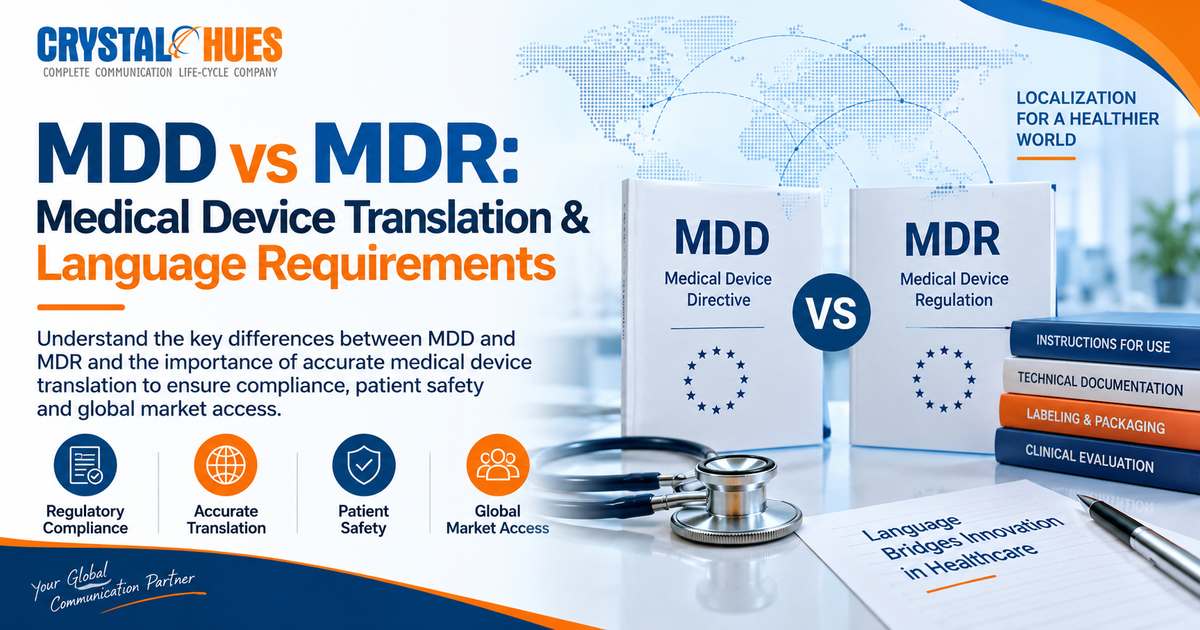
MDD vs MDR: Medical Device Translation & Language Requirements
Introduction
Medical device manufacturers selling across the EU have spent the past several years adjusting to a major regulatory shift from MDD to MDR. Understanding this difference matters beyond compliance teams alone, since it also changes how labelling, instructions for use, and other documentation need to be prepared in multiple languages.
What Is MDD?
MDD stands
for the Medical Device Directive, formally Directive 93/42/EEC.
Introduced in 1993, it served as the regulatory framework for medical
devices sold across the EU for close to three decades.
As a directive, MDD required each member state to transpose its requirements into national law, which meant some variation existed in how the rules were applied from country to country. It covered core areas like classification, essential requirements for safety and performance, and conformity assessment, giving manufacturers a route to CE marking.
What Is MDR?
MDR stands
for the Medical Device Regulation, formally Regulation (EU) 2017/745.
Adopted in April 2017, it came into full application on 26 May 2021,
replacing MDD as the current legal framework for medical devices in the EU.
Unlike a directive, a regulation applies directly and uniformly across every member state, without separate national transposition. MDR builds on the foundation MDD established, retaining familiar elements like device classification, while introducing stronger requirements around clinical evidence, post market surveillance, and traceability through the Unique Device Identification system.
MDD vs MDR: Key Differences
The difference majorly lies in the implementation
and the uniformity of both. Unlike a directive, regulations are broad, more
plausible and have more checks and balances which helps maintain quality
service delivery.
MDD operated as a directive needing
national transposition, while MDR applies directly across every member state.
Scope grew considerably too, from 23 articles and 12 annexes under MDD to 123
articles and 17 annexes under MDR, along with stronger clinical evaluation and
post market follow up obligations.
The scope of covered devices also widened,
bringing in certain aesthetic and borderline products that sat outside MDD's
reach. Because MDD relied on national implementation, enforcement varied
somewhat by country. MDR's direct application brings greater consistency,
though individual member states still retain authority over areas like language
requirements.
Taken together, MDR builds on MDD's logic rather than replacing it outright. Device classes remain largely the same. What changes is the depth of evidence, documentation, and ongoing monitoring manufacturers must maintain.
How MDR Affects Translation &
Language Requirements
MDR Article 10(11) sets the core language
obligation for manufacturers. It states that a device must be accompanied by
the information described in Annex I, Section 23, in the official Union
language or languages determined by the member state where the device is made
available to users or patients.
This wording places the language decision
with each individual member state rather than fixing one EU wide language list.
In practice, the label, packaging, and instructions for use may need to appear
in the national language of every country where a device is sold, though
requirements differ by market. Some member states accept English for
professional use devices under defined conditions, while others require
national language translation regardless of audience. A manufacturer selling
across several EU markets can end up preparing documentation in a meaningful
number of official languages, depending entirely on where the device reaches
patients or professionals.
Annex I, Section 23 outlines what this accompanying information must include, covering identification details, safety information, and usage instructions. This content forms the foundation for what medical device translation teams work with, whether the source is an IFU, a label, or a related regulatory document. Manufacturers exploring medical translation services for MDR documentation often start by mapping exactly which markets and languages their device touches before translation begins.
Why Medical Device Translation
Matters
Accurate translation plays a direct role in
patient safety and regulatory standing. A label or IFU that misstates a dosage,
a contraindication, or a usage instruction can create real risk for patients
and real exposure for manufacturers during Notified Body review.
Consistency across languages matters just as much. Terminology used in a device label should match the terminology used in its IFU and technical documentation, so professionals and patients encounter the same information regardless of which language version they read. This is particularly relevant for life sciences companies managing large device portfolios across multiple EU markets, where small terminology drift across documents can create confusion during audits. Many manufacturers pair this work with life sciences translation services that understand both the linguistic and regulatory context involved.
What Companies Should Consider
Manufacturers preparing device documentation for EU markets should confirm the specific language requirements for every member state where the device will be sold, since these vary rather than following one fixed EU list. Maintaining consistent terminology across labels, IFUs, and technical files in every language version helps prevent confusion during review, while building translation timelines into the broader MDR compliance schedule keeps the process from becoming a bottleneck close to launch. Working with translation teams who understand medical device terminology, alongside a clear review process before documentation reaches the market, closes the loop on quality.
FAQs
What is MDD?
MDD is a regulatory directive for medical
devices introduced in 1993 for EU.
What is MDR?
It is an upgrade in regulation of medical
devices and currently serves across all member states since 26 May 2021.
What is the difference between MDD and
MDR?
MDR is a regulation whereas MDD was a
directive which puts more emphasis on clinical evidence improving the quality
of medical devices.
Does MDR have language requirements?
Yes.
Article 10(11) requires that device labels, IFUs, and related accompanying
information appear in the official language or languages set by each member
state where the device is sold.
Are MDR language requirements the same
in every EU country?
No.
Each member state sets its own official language requirements under Article
10(11), so manufacturers need a market-by-market view rather than one standard
list.
Conclusion
The shift from MDD to MDR changed far more than terminology. It raised the bar for clinical evidence, traceability, and ongoing oversight, while leaving language requirements in the hands of individual member states. For manufacturers selling across the EU, medical device translation remains a practical, ongoing part of staying compliant across every market a device reaches. Crystal Hues supports medical device and life sciences companies working through this kind of multilingual documentation need.