Most Common Languages Spoken in Florida
Introduction
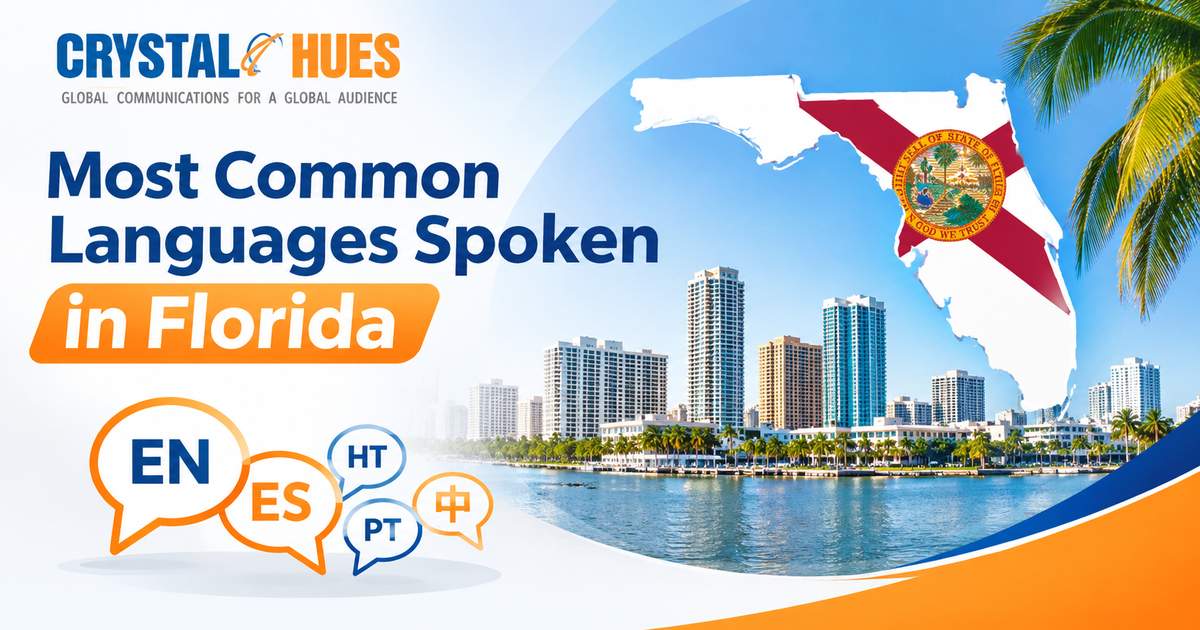
Flanked by Atlantic on one side and Gulf of Mexico on other, Florida is the southeasternmost U.S. state with one of the most linguistically varied population in the country. It is shaped by long-standing Caribbean and Latin American ties, steady migration and a large tourism economy. English is the most widely spoken language at home, and Spanish is by far the most common language after it. Haitian and Portuguese follow.
What Are the Most Common Languages Spoken in Florida?
Florida
being a touristy place has people from all over the place with different
languages and cultures.
In 2024, about 7.11 million Floridians aged
5 and older spoke a language other than English at home, roughly one in three
residents. Excluding English, Spanish is the most common language spoken in
Florida homes, and about 73% of people speaking a non-English language spoke
Spanish. Haitian and Portuguese rank next after Spanish. These figures come
from USA Facts’ analysis of ACS data.
So, the most spoken language in Florida besides English is Spanish, followed by Haitian and then Portuguese. Several other languages, including French, Chinese and Vietnamese, are also spoken at home across the state, but their ranking varies by dataset and year, so check the exact ACS table before quoting a position.
Spanish in Florida
Spanish is a central part of everyday
communication in Florida. It is heard in homes, workplaces, schools, shops,
media and public life in many communities across the state.
As noted above, Spanish accounts for nearly
three-quarters of non-English home language use. The number of Floridians
speaking Spanish at home grew 16.2% between 2018 and 2024. A household-based
viewpoints the same way. In 2023, Spanish was the most common non-English
language in Florida households, with 22.2% of households reporting it as their
shared language at home.
Note that “Spanish” is one language category, not a single community. Speakers in Florida have different origins, dialects and vocabulary, and a statewide number should not be used to describe the language habits of any one city or group.
Haitian Creole and Other Caribbean Languages
Haitian Creole is the second most spoken non-English language in Florida at home.
The state’s role in its use across the country is striking. In 2024, Florida
was home to 49.2% of all U.S. speakers of Haitian, the highest state share for
any language in that analysis.
A note on terminology helps here. The Census Bureau lists the category as “Haitian”. It also includes some French-based Caribbean creoles that are generally mutually intelligible with it, while creoles that are not intelligible with Haitian are grouped under “Other and unspecified languages”. Haitian Creole is a distinct language, separate from French, and the two should not be combined in a count. French is reported as its own category in ACS tables.
Portuguese, French and Other Languages
Portuguese is
the third most common non-English language in the 2024 ACS-based ranking. It is
also the language with the second-highest Florida share of U.S. speakers, at
19.1%.
French and other languages appear further down the list. In the 2017–2021 ACS five-year period, French was the third most common language after Haitian and Portuguese when English and Spanish were set aside. That is an older release than the 2024 data above, and the ordering of smaller languages can shift between years, so it should not be compared directly with the 2024 figures. This is also where the measure matters most. A language spoken at home is not the same as a language someone speaks fluently or reads and writes, so a lower rank does not mean a smaller or less active community.
How Language Patterns Vary Across Florida
Statewide rankings describe Florida as a
whole. They do not describe each county or metro area. Language use in South
Florida, Central Florida, the Tampa Bay region and the Panhandle can look quite
different, and a language that is small statewide can be a major part of life
in a particular community.
Official county-level ACS tables show these
differences, for example in the share of residents who speak Spanish or Haitian
Creole at home. To compare areas fairly, use the same ACS table, the same year
and the same population definition for every place.
Readers interested in how language diversity looks elsewhere can explore the languages spoken across the Middle East for a regional comparison.
Why Is Florida Linguistically Diverse?
Florida’s language diversity does not come
from one cause. Several factors work together, and each adds a different layer
to the state’s language landscape.
Migration.
This is the biggest factor. People have arrived in Florida from Latin America,
the Caribbean, Europe and other regions for work, safety, family reunion and
opportunity.
Family and community networks. Once people settle, relatives, friends and neighbours often follow
and choose to live nearby. Shared homes, religious and cultural groups, local
shops and community organizations create places where a language is used daily.
Work and the economy. Florida’s economy includes hospitality, healthcare, construction,
trade and services, where employers and customers often communicate in more
than one language.
Tourism. Millions
of visitors travel to Florida each year, and many bring their own languages.
Hotels, attractions, restaurants and transport services adapt by offering
information, signage and support in several languages.
Education.
Universities, colleges and schools draw international students and families
from many countries. Schools also support students who speak a language other
than English at home, and language courses are available in many places
Regional connections. Florida’s location and its long-standing links to the Caribbean and Latin America keep travel, trade and family ties active.
How Languages Shape Everyday Life in
Florida
Language shows up in practical ways.
Schools and public offices share information in more than one language. Local
media, radio and community organizations serve different language groups.
Healthcare, emergency notices and government forms are often provided in
several languages so that residents can access them.
Culture and tourism benefit too. Food,
music, festivals and signage reflect the many languages present across the
state. For visitors, basic phrases in Spanish can be useful in many areas,
though the best choice of language depends on the community.
Conclusion
The tourism sector has boomed in United States and vicinity to beautiful beaches make Florida a top destination for people all around the world. Florida’s language landscape is broad and changing. English is the main language at home, Spanish is the most common language after it, and Haitian Creole and Portuguese are important parts of the picture. For another view of how national language diversity can look, see this article on language diversity in Australia.
Frequently Asked Questions
What is the most spoken language in
Florida besides English?
Besides English, people speak Spanish
measured by language spoken at home, not fluency.
Is Spanish widely spoken in Florida?
Yes, it’s widely spoken in Florida
according to official ACS data.
Is Haitian Creole spoken in Florida?
Yes, Haitian Creole is the second most
common non-English language at home.
How many languages are spoken in
Florida?
It’s hard to put a number around that but the Census Bureau groups home languages into broad categories, and any count depends on how languages are defined and which year is used.