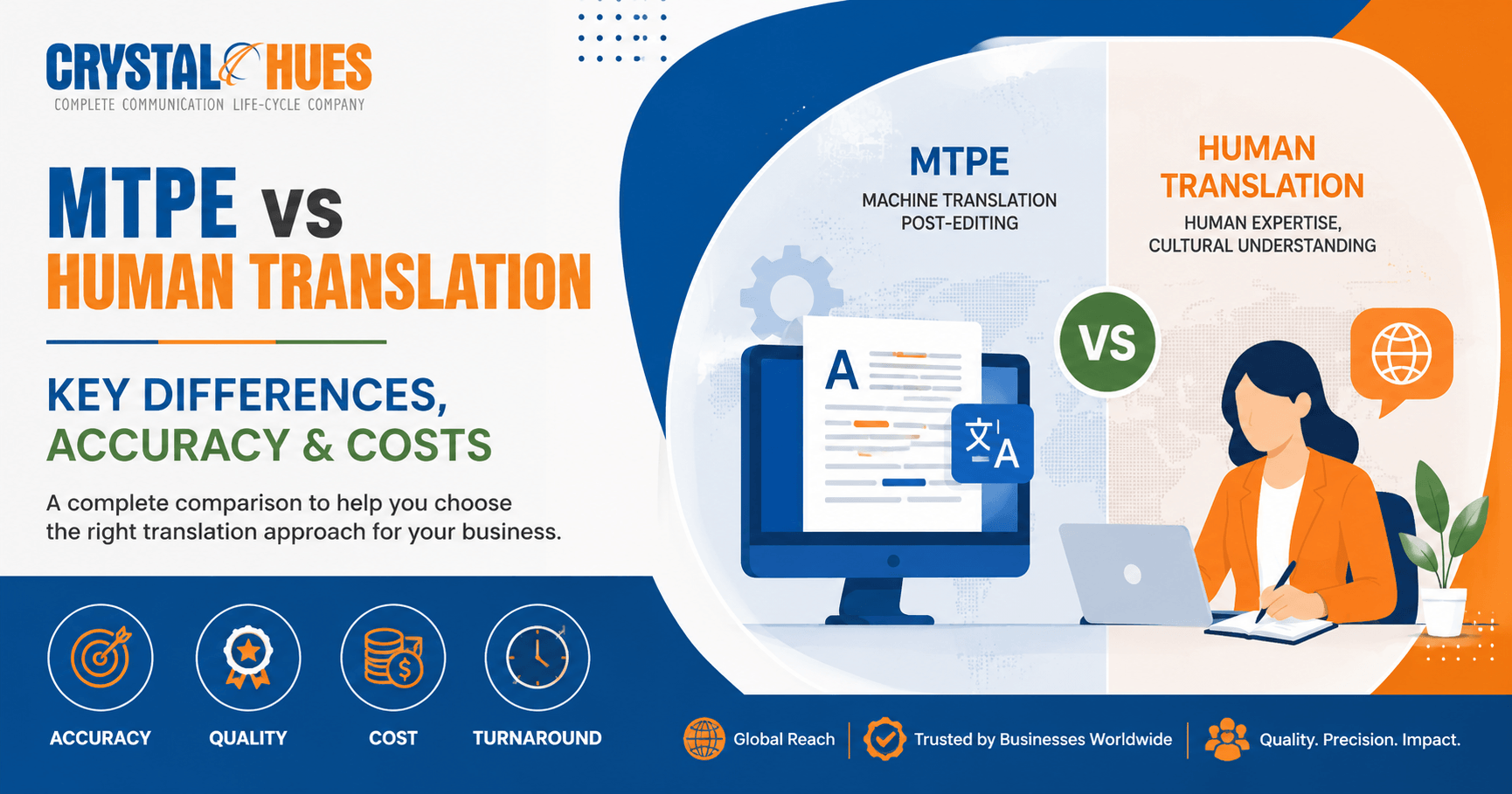
MTPE vs Human Translation: Key Differences, Accuracy & Costs
What is MTPE and Human Translation?
MTPE ( Machine Translation Post Editing ) involves a
machine layer translating the text followed by a human linguist editing it for accuracy.
Human translation does away with the machine draft, directly translating
from the source text leveraging human loop throughout the process.
The evolving business requirements in
translation industry have room for both to coexist, depending upon the scope
and nature of work. MTPE suits high volume, repetitive content where speed and
cost efficiency matter most, while human translation suits emotionally or
legally sensitive content where tone, nuance, and brand voice carry real
weight. Many businesses use both, matched to different content types within the
same project.
Here is a clear way to think through the decision, along with how Crystal Hues helps clients choose.
Where is MTPE most useful
MTPE works best for high volume content
where speed and consistency matter more than literary nuance. Product
catalogues, internal documentation, support articles, and repetitive technical
content are strong candidates. Crystal Hues holds ISO 18587 certification for
this exact process, the international standard that governs how post editing
should be done properly.
How Crystal Hues Runs the MTPE Process
The workflow starts with a machine generated first draft, then moves to linguists fluent in both the source and target language, who review every line for accuracy, fluency, and cultural fit, including local references like city names and landmarks that machines often distort. A dedicated quality assurance layer checks the edited content against client requirements before delivery. Every project runs under strict data security procedures, keeping client content protected through the entire process, and under ISO 18587 certification, the standard built specifically for post editing quality.
Where is Human Translation most useful
Human translation earns its place wherever tone, emotion, or precision carries real weight. Marketing campaigns, legal contracts, literary works, and clinical trial documents all fall here, since a wrong tonal choice or a missed cultural nuance carries real consequences. Crystal Hues holds ISO 17100 certification for translation; the standard built specifically around this level of quality control.
Is cost the real Question?
Framing this as which option is cheaper
misses the point and often leads teams to the wrong choice for their actual
content. A law firm choosing MTPE for a contract to save money risks a costly
misunderstanding later. A retail brand insisting on full human translation for
ten thousand product descriptions burns budget and time that a hybrid workflow
would have saved entirely.
The better questions to ask are these. How sensitive is the tone? How large is the volume? How fast does this need to ship? How much cultural nuance does the content carry?
How to Choose between MTPE and Human Translation?
Choosing either one of them or both can be
a decision fatigue hampering your business workflows. Let’s simplify the
decision by considering a few key factors.
1 When the content is high volume,
repetitive and turnaround time matters more than literary polish. Go for MTPE.
2 When the content is emotionally or
legally sensitive, brand voice and tone need to feel native and accurate, Human
Translation can be a better choice.
Depending on your business viability and project feasibility, make an informed decision. You can also reach out to Crystal Hues Limited for overlooking the whole process from audit to post delivery.
How Crystal Hues Helps Teams Decide
Rather than pushing one service by default, Crystal Hues reviews the content type, audience, and turnaround needs upfront, then recommends the workflow that fits, sometimes a blend of both within the same project. Every engagement runs under the relevant ISO certification, 18587 for MTPE and 17100 for full human translation, so quality control stays consistent regardless of which path a project takes.
Frequently Asked Questions (FAQs)
Is MTPE lower quality than human
translation?
MTPE follows a certified quality process
under ISO 18587, with a trained linguist editing every machine generated draft.
It suits high volume, straightforward content well. Highly nuanced or
emotionally sensitive content still benefits more from full human translation.
Can one project use both MTPE and human
translation?
Yes. Many projects split content by
sensitivity, using MTPE for bulk or repetitive sections and human translation
for headlines, legal language, or brand critical copy within the same
deliverable.
How do I know which one my project
needs?
Look at volume, turnaround time, and how much the tone matters to your audience. High volume and fast turnaround favour MTPE. High sensitivity and brand voice favour human translation.
Conclusion
MTPE and human translation solve different
problems, and treating the choice as a cost battle usually leads teams to the
wrong workflow for their content. The better approach starts with the content
itself, its volume, its sensitivity, and its audience, then works backward to
the right process.
Crystal Hues
runs both services under dedicated ISO certifications and helps clients match
the right workflow to the right content rather than defaulting to one option.
If your next project needs a translation plan that fits the content instead of
guessing, talk to Crystal Hues about MTPE services or
Human Translation
services built around what you're shipping.