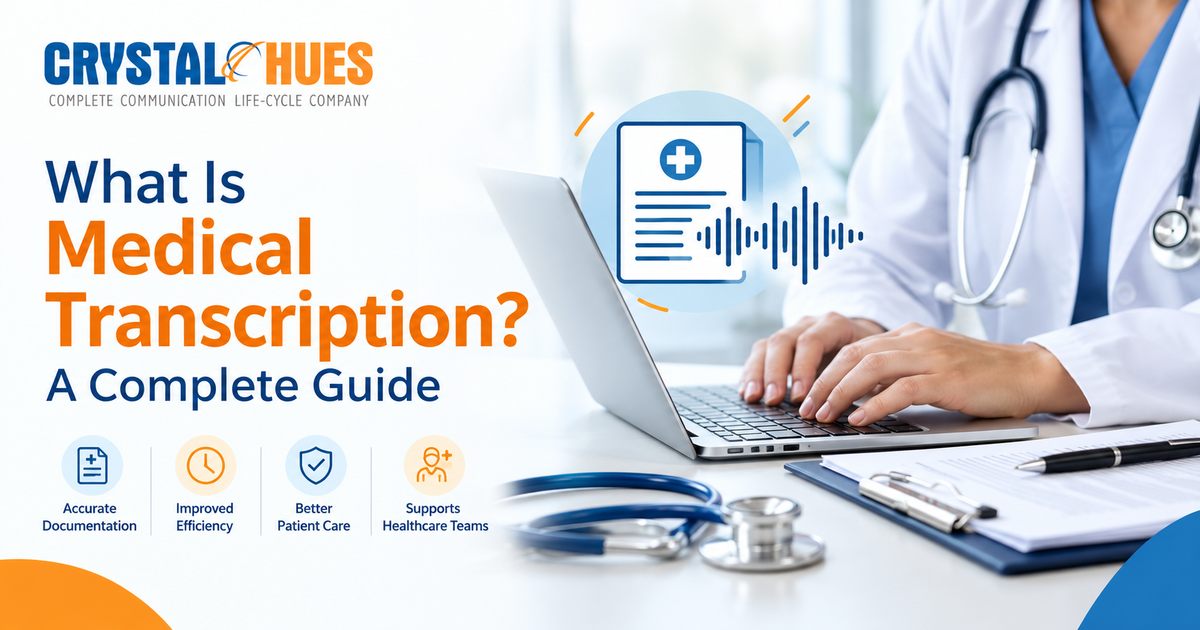
What Is Medical Transcription? A Complete Guide
Accurate documentation forms a central part of medical industry as it
forms the trust layer for recorded patient records. Medical Transcription
is the process of converting recorded or dictated healthcare information, such
as physician notes or patient consultations, into accurate written
documentation. It turns spoken clinical detail into structured records that
hospitals, clinics and healthcare professionals rely on for patient files,
reports and everyday workflow.
What Is Medical Transcription?
Medical Transcription converts spoken or recorded content into written document becoming
part of a patient's medical record, supporting everything from ongoing
treatment to administrative documentation.
So, it’s very important to have subject matter experts like transcriptionists that understands clinical languages as the cost of getting it wrong can be disastrous.
Medical Transcription Process
Being a sensitive space, medical transcription follows a structured workflow.
- Firstly, the dictation of records take place with proper recording.
- Then, the recording
reaches the transcription team through a secure channel.
- A transcriptionist listens closely to the recording, working
through unclear audio, accents or background context as needed.
- Medical terminology and clinical context get applied to
interpret specialised language accurately.
- The content gets transcribed into structured, formatted written
documentation.
- A quality review pass checks the transcript against the
original recording before it reaches the final format.
- The completed transcript gets delivered back to the healthcare provider for use in patient records.
What Does a Medical Transcriptionist Do?
To put it simply, medical transcription
converts recorded or dictated healthcare content to accurate written
documentation. Given the sensitive of healthcare as an industry, a lot of things
need to be taken care of.
A medical transcriptionist listens to
recorded or dictated healthcare content and converts it into accurate written
documentation recognising medical terminology, understanding clinical context,
formatting the output correctly and proofreading the result before delivery.
They also ensure confidentiality throughout the whole process since medical transcription deals directly with patient records and healthcare documentation. Careful handling of sensitive information runs through every stage of the process, from receiving the original recording to delivering the finished transcript.
Medical Transcription Importance
Healthcare industries emphasize on accuracy
and guardrails. Medical transcription enables to build trust which itself is a biggest
multiplier. Written patient records are easier to review, reference and share
across a care team than recorded audio alone, particularly when multiple
professionals need access to the same information over time.
Accurate documentation keeps healthcare
organisations organised and supports smoother day to day workflow.
Medical transcription also reduces the documentation burden on healthcare providers directly as providers can dictate their notes bypassing manual process and let a transcription process handle the conversion into structured written text, freeing up time for patient care.
Medical Transcription vs General Transcription
Medical transcription deals specifically
with clinical and healthcare material, requiring familiarity with medical
terminology, physician notes and patient records. General transcription covers
broader content like interviews, meetings or media, where subject matter varies
and specialised medical knowledge plays no role.
The users differ accordingly. Medical transcription primarily serves hospitals, clinics and healthcare professionals, while general transcription serves a wider range of businesses, media organisations and individuals working with recorded audio across any industry.
Medical Transcription vs Medical Translation
Both these terms are interchangeably used
and can be confused often though they solve different problems.
These two services get confused often, medical
transcription converts spoken medical content into written text, generally
within the same language, turning a doctor's dictated notes into a written
record. Medical translation, on the other hand, converts written or spoken
medical content from one language into another, adapting patient documents or
clinical material for a different language audience.
A hospital working with international patients might need both transcribing a consultation into written form, then working with medical translation services to make that documentation accessible in another language.
Human vs AI Medical Transcription
Automated or AI assisted transcription
tools have improved considerably and can handle straightforward dictation
reasonably well. Medical content, however, often includes specialised
terminology, unclear audio or context that benefits from human review. Many
transcription workflows combine both, using automated tools for an initial
draft and human review to catch terminology errors, formatting issues or
unclear passages before the final version gets delivered.
Neither approach works best for every
situation. The right balance depends on the complexity of the content, the
clarity of the recording and how much precision a given document requires.
Who Uses Medical Transcription
Services?
Medical Transcription find its usage across different personas. Hospitals, clinics, individual physicians and broader healthcare organisations all rely on medical transcription services to keep patient records and clinical documentation organised. Any healthcare provider who dictates notes, consultations or reports regularly can benefit from a structured transcription process rather than manually typing documentation after every patient interaction.
When Do You need Professional Medical Transcription Services?
If your organisation handles large volume
of dictated medical reports with cluttered records and causing friction in
smooth flow of process, you should opt for Professional Medical Transcription
Services.
Organisations handling a steady volume of
dictated medical reports, physician notes or patient consultations often reach
a point where structured, professional support makes sense, rather than
managing transcription internally on an ad hoc basis. This becomes especially
relevant for practices juggling multiple providers, specialised terminology or
a growing volume of healthcare documentation.
If your organisation needs support converting medical recordings or dictated content into structured written documentation, Crystal Hues' medical transcription services can support that process, alongside broader transcription services for related documentation needs.
FAQs
What is medical transcription?
Medical transcription helps to convert recorded healthcare information into accurate written documentation.
How does medical transcription work?
It follows the process of reviews and
accuracy check before delivered in a suitable format.
What does a medical transcriptionist do?
A medical transcriptionist is tasked with
hearing the recordings and converting into properly formatted documentation.
What is the difference between medical
transcription and medical translation?
Main difference lies in the retention of language. Transcription converts spoken content into written text within the same language, while translation converts content from one language into another.
Is medical transcription done by AI?
AI can play its part with automating repetitive tasks while human review has the final say ensuring accuracy in medical terminology.
In a nutshell
Trust is the real currency in healthcare industries. Medical transcription enables a smooth accurate flow of information downstream covering different industries. Understanding how the process works, and where it differs from general transcription or medical translation, helps healthcare organisations choose the right support for their documentation needs. Crystal Hues offers professional medical transcription services for healthcare providers looking to convert recorded or dictated content into structured, reliable documentation.