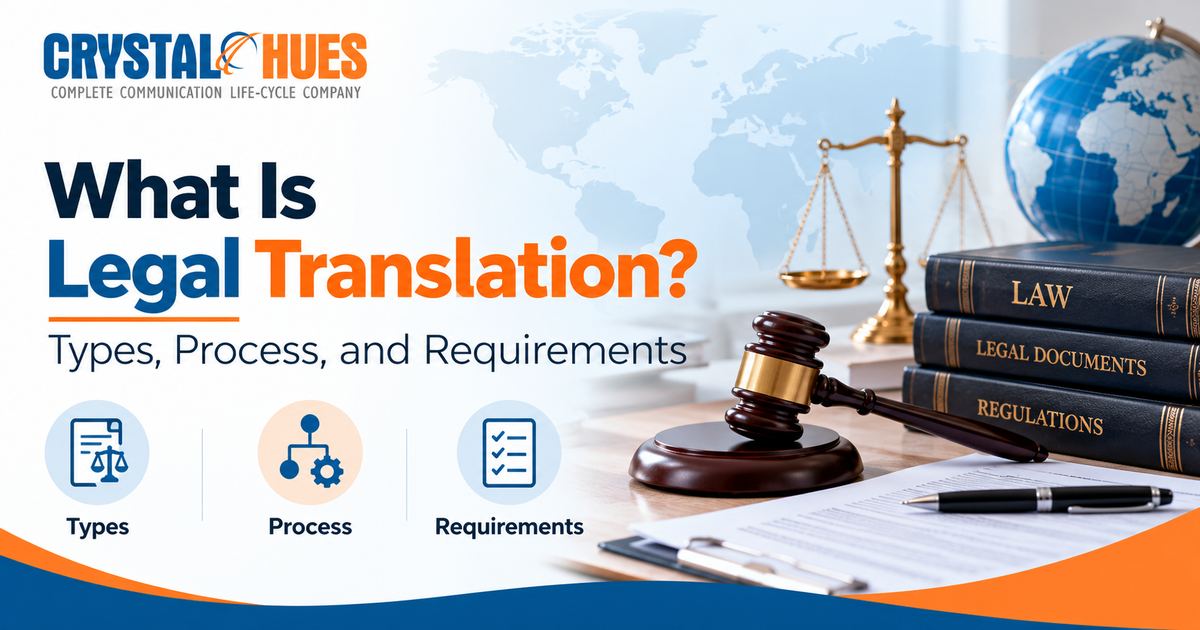
What Is Legal Translation? Types, Process, and Requirements
Introduction
Global businesses need accurate compliance documents and certificates that is legally acceptable. For example, a company signs a supplier contract in English, and its partner abroad needs to read it and rely on it in another language. In each case, a small wording mistake can change rights or duties. This guide explains what legal translation is, which documents may need it, how the process works and how quality is checked. If you already have a file in hand, you can learn more about professional legal document translation as you read.
What Is Legal Translation?
Legal translation is the process of
transferring legal text from one language into another while preserving its
meaning, defined terms, context and, as far as possible, document structure. It
is carried out for contracts, court papers, corporate records and other
documents that carry legal weight.
It
is different from general translation as a general translator aims for a
natural, accurate message. A legal translator must do that and respect the
terminology of the relevant legal system, because a word in a contract may have
a specific legal meaning. For this reason, legal translation usually calls for
subject knowledge along with strong language skills. It sits within the wider
field of professional
translation services, but it asks for a more careful and controlled
approach.
Which Documents May Need Legal Translation?
Legal Documents spans across sectors. Every
company, private or government need to adhere to rule of law through accurate
legal documents at its disposal.
Many document types fall into this
category, including:
- Contracts and agreements, such as employment, supply, licensing
and partnership contracts
- Court filings, judgments, affidavits and witness statements
- Corporate and compliance documents, such as articles of
association, board resolutions, policies and financial
agreements and reports
- Certificates and personal legal records, such as birth,
marriage and identity documents
- Intellectual property documents, such as patents, trademarks
and licences
Some documents belong to specialist fields. Informed consent forms in clinical research, for example, need expertise in both law and clinical terms, and our clinical trial translation services cover that area. Legal records in healthcare may also call for medical translation services. Whether a document needs translation at all depends on its purpose, the jurisdiction and the receiving authority.
Main Types of Legal Translation
Legal translation is usually grouped by
document and use case. Contract translation covers agreements between parties.
Court document translation, sometimes called litigation translation, covers
filings, evidence and judgments. Corporate legal translation covers company
records and governance papers, while regulatory and compliance translation
covers policies and official submissions. Personal legal document translation
covers certificates and records that individuals submit to authorities.
You may also hear the terms certified translation, sworn translation and notarized translation. In general, a certified translation comes with a signed statement from the translator or provider about completeness and accuracy. A sworn translation is made by a translator authorised by a court or authority in certain countries. A notarized translation involves a notary public who confirms the signature or identity of the person who signed. Rules vary by jurisdiction, and the three cannot be treated as interchangeable, so always check what the receiving authority asks for.
How Does the Legal Translation Process Work?
A careful legal translation process usually
follows these steps:
- Confirm the purpose and requirements. Find out who will receive the document and what format or
certification they expect.
- Review the source files. Check that
the files are complete and readable and note any unclear passages.
- Agree the language pair and terminology. Settle on key terms and defined terms before work begins.
- Translate. A translator with
relevant legal knowledge produces the target text.
- Review. A qualified second linguist
checks meaning and legal terminology.
- Verify the details. Names, dates,
numbers, references and formatting are checked closely.
- Deliver in the required format. Certification or notarization is added only when the receiving authority requires it.
What Are the Common Challenges in Legal Translation?
Legal language is precise, and that creates
real challenges. Terminology depends on the jurisdiction, and some concepts
have no direct equivalent in another legal system. Wording can be ambiguous,
defined terms must stay consistent from the first page to the last, and names
and dates leave no room for error. Formatting, confidentiality and tight
deadlines add further pressure.
Here is a short example. The common law idea of “consideration” in a contract has no exact counterpart in many civil law systems, so a translator must choose wording that conveys the concept without changing the legal meaning.
How Is Quality Checked in Legal Translation?
Quality checks work best in layers. Typical
checks include:
- Completeness, to confirm that no sentence, clause or table is
missing
- Terminology consistency across the whole document
- Preservation of meaning, compared closely with the source
- Names, numbers and dates
- Proofreading and independent review
What Guardrails Protect a Legal Translation?
A guardrail is a safeguard that keeps the main goal from coming at the expense of other goals. In legal translation, the main goal is delivering a usable document on time, and speed should never cost accuracy, confidentiality or the exact meaning of defined terms. Guardrails make that balance possible. Common examples include an agreed glossary of defined terms, independent review by a second linguist, a final check of names, dates and numbers, and secure handling of confidential files.
Choosing a Legal Translation Provider
Given the ubiquitous nature of legal
documents spread across sectors, choosing a right Legal Translation Provider
becomes an important decision.
One should look for a provider with experience in your type of document and the language pair you need. Ask how the work is reviewed, who checks legal terminology and how confidential files are handled. Confirm that the provider can deliver in the format you need and follow the receiving authority’s instructions, such as a specific certification statement. Clear, direct answers to these questions usually say more than any claim about being the best.
Frequently Asked Questions
What is Legal Translation?
Legal translation is the transfer of legal
text from one language into another while preserving meaning, defined terms and
context.
Does every legal document need certified
translation?
No, it depends on the receiving authority
requirements, so confirm them before ordering. This article is general
information and never legal advice.
How is legal translation different from
general translation?
Legal translation follows the terminology
and tone of a defined legal system while general translation does not follow
any structure and just translates the meaning.
What affects turnaround time?
Document length, subject complexity, language pair, file condition, review
steps and any certification need all effect timing.
Conclusion
The advent of technologies has increased
the speed and scale of global businesses. Risk of fake and unscrupulous
businesses have proliferated putting emphasis on the accurate legal translation
documents which verify the authenticity of the company.
Legal translation helps people and
organisations rely on contracts, court papers and records across languages, and
it works best when the process, the review and the receiving authority’s
requirements are clear from the start.
Need a legal document translated? Explore
Crystal Hues’ legal
translation services or contact the team to discuss your language pair,
document type and the receiving authority’s requirements.